Reviews
Every correction issued against this week's reports, and why
Every correction issued against this week's reports, with the reason for each and the source document that settled it, all gathered in one place.
A correction is a small piece of paperwork with a long tail. It changes a field, it leaves a note, and it tells the next reader that the first version was wrong.
This week's list runs to seven entries. Each one is below with the reason it was issued, because the reason is the part that stops the same error arriving again.
What to take away
- Standing gets you a reply. Evidence gets the change made. Keeping those apart is what stops a desk from arbitrating a family.
- Where two requests conflict, the answer is usually to record less rather than to choose between them.
- A refusal is a decision and needs a record, or the next person to ask will get a different answer.
- Every correction below was settled by a document, not by who asked. Two were settled by marking the field disputed.
This week's corrections
| Entry | Field changed | Reason issued | What settled it |
|---|---|---|---|
| Marlow, Ada | Date of death, 4 Sept to 3 Sept | Family notice carried the wrong day | Funeral home record supplied by the funeral director |
| Okonkwo, Peter | Middle name removed | Name published was a confirmation name, not a legal one | State vital records index entry |
| Bright, Helen | Age, 71 to 74 | Age taken from a reader comment | Death certificate request confirmed by the county clerk |
| Sandoval, Luis | Surviving sibling removed | Sibling asked not to be listed | Discretionary field, contested, removed |
| Ferris, Daniel | Occupation corrected | Employer named was a client, not the employer | Payroll confirmation from the employer |
| Achterberg, Nils | Entry marked disputed | Two dates of birth in circulation | Both sources recorded, neither chosen |
| Whitcombe, Grace | Photograph replaced | Image showed a different person of the same name | Family supplied the correct photograph |
The Marlow change is the ordinary case: a document arrived, a date moved, a note went up. The Okonkwo change is the one readers ask about most, because the name that was removed had appeared in a paid notice.
Why the Okonkwo name came off
Paid notices and news obituaries are different documents with different rules. A funeral home's notice is placed by the family and printed as submitted. A news obituary is written by the publication and checked against records.
The name published was a confirmation name. It was correct in the church, and it was not the name on the death record. The entry now carries the legal name, with the confirmation name noted in the body text rather than the heading.
Why the Achterberg entry is still unresolved
Two dates of birth are in circulation and neither source is closer to the event than the other. One is a Social Security record, one is a family recollection with a baptismal certificate behind it.
The entry is marked disputed with both values shown. That looks like a failure and it is not. It is the accurate state of the evidence, and it is better than a clean-looking entry that is wrong.
Fact-checking practice comes down to the same discipline: find the original assertion and ask what the person making it was in a position to know. Poynter's fact-checking material sets out that method.
Why the Whitcombe photograph was replaced
The image was of a different Grace Whitcombe, taken from an image search and never checked against the family. It ran for nine hours.
The replacement came from the family. Where a family supplies a photograph, the desk records who supplied it and when, and does not use an image it cannot trace to a named source.
What settles a factual dispute
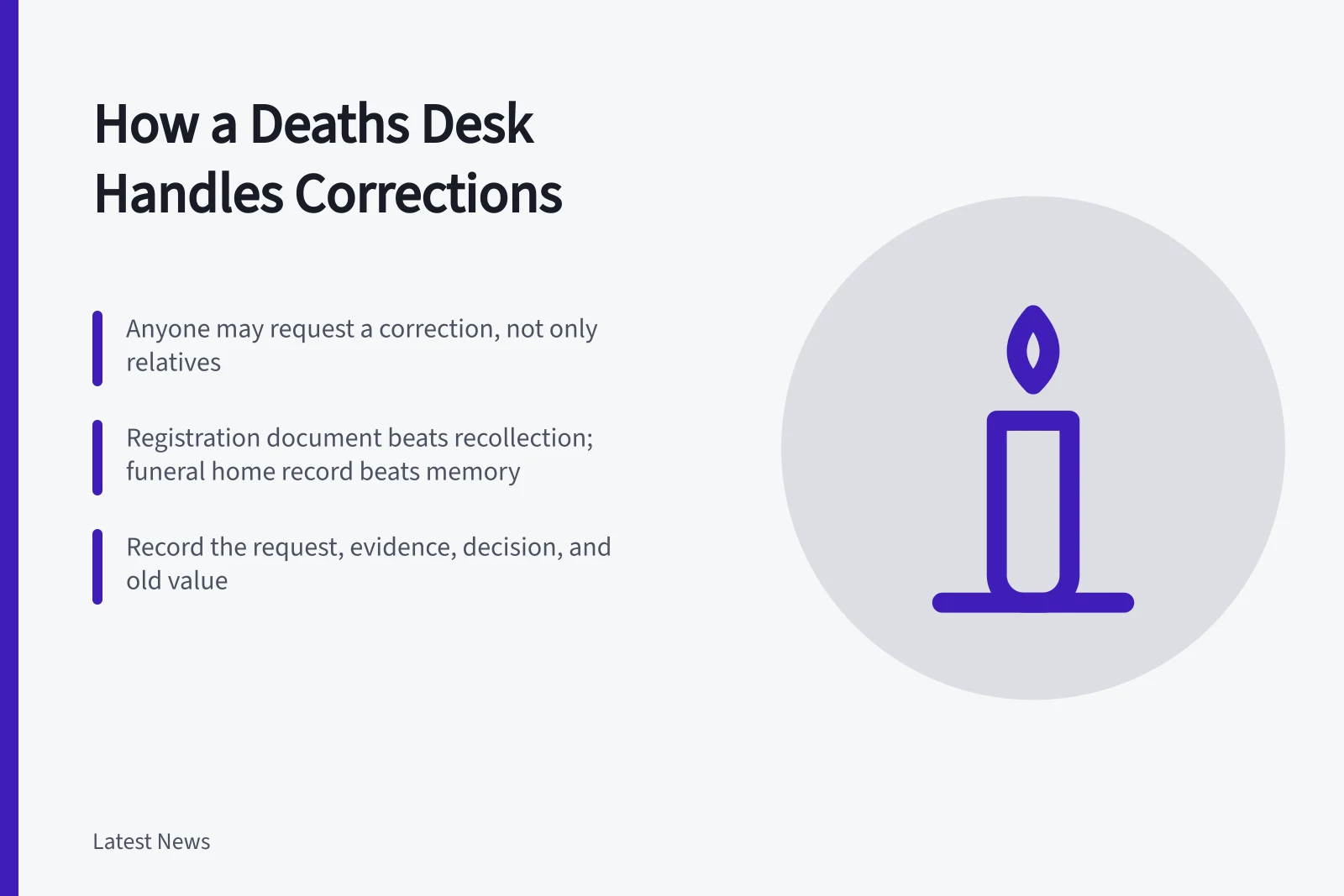
Proximity to the event, not authority in the family. A registration document beats a recollection. A funeral home's record beats a cousin's memory. A contemporaneous notice beats an account given years later.
Where a civil record would settle it, say so and say who can obtain one. A desk cannot get it, but a relative frequently can. The National Archives guidance on vital records sets out where such records live in one country.
When two requests conflict
Families are not single entities, and a death makes that visible. The forms are recognizable: two people each describing themselves as the family contact, a dispute over which name a person is recorded under, disagreement about whether somebody is listed among survivors.
Handling conflicting requests
Is the contested field factual or discretionary?
Factual -> mark disputed, record both values
Discretionary -> remove the detail
The workable principles are narrow:
- Do not decide who speaks for the family. That is not a publisher's role and any answer will be wrong for somebody.
- Separate the factual from the discretionary. A date is checkable and gets settled by documents. Who is named is a choice.
- Where a discretionary detail is contested, remove it. A shorter entry offends nobody and is still accurate.
- Where a factual field is contested, mark it disputed rather than picking, and say what each source is.
- Tell both parties the same thing, in writing. Two different answers to two relatives makes the dispute worse.
What gets recorded either way
- The request, who made it, what they asked for, and the date.
- What evidence was supplied.
- What the desk did, including doing nothing, and why.
- Where two requests conflicted, that they conflicted, without characterizing either party.
- Whether the entry now differs from what was published, and where the old value is visible.
The last item is what makes the whole thing auditable. Someone read the original page and may have relied on it, so the correction has to be findable from there rather than only from the new version.
What the correction log records
- The request, who made it, what they asked, and the date
- What evidence was supplied
- What the desk did, including doing nothing, and why
- Where two requests conflicted, that they conflicted
- Whether the entry differs from what was published
The weekly record itself is described in deaths this week, and how an entry moves between states during a week in deaths today. For corrections applied to a closed period rather than a live one, see deaths by month and deaths by year. For requests about material that is years old, see anniversaries and archives.
Common questions
Do you need proof of relationship?
For a factual correction, no. The document does the work. For a discretionary request, some evidence of connection is reasonable and should be asked for gently.
What if somebody asks for an entry to be removed entirely?
That is a different request from a correction and should be answered separately, with a plain statement of what the publication will and will not do.
Can a desk take sides if one relative is obviously right?
It can follow evidence, which sometimes looks like taking sides. What it should not do is decide who has authority within a family.
How quickly should a correction appear?
A documented factual fix within days. A contested or discretionary request takes longer, and the person asking should be told that at the start.