Reviews
Part of Science and technology announcements: a reporting guide
Science and technology announcement types compared
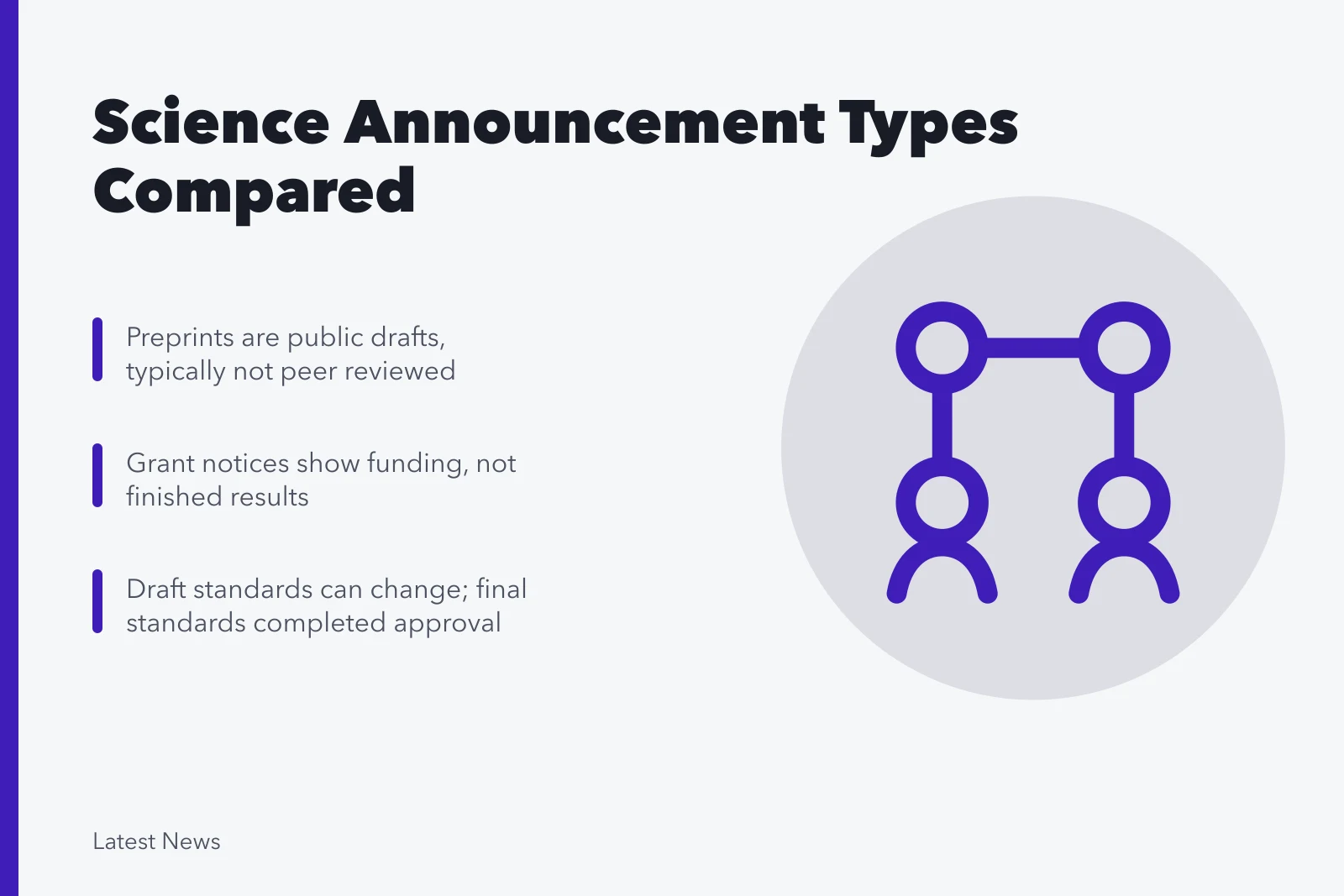
Science announcement types compared across preprints, peer-reviewed papers, datasets, grants, patents, prototypes, standards drafts, final standards, and releases.
What to take away
- A preprint is public research work that has not completed journal peer review.
- A grant describes funded work, not a finished result.
- A patent protects claimed invention rights, not performance.
- A draft standard is open to change; a final standard has completed a stated approval process.
- A press release describes an announcement and may not contain the full evidence.
Different document types can share the same confident headline while carrying very different status. The comparison below keeps the status field visible. The parent science announcement reporting guide covers the reporting workflow around these records.
What it establishes
- Preprint
- Authors publicly posted a research manuscript
- Version of record
- The journal's official published version
- Dataset release
- Specified data are available under stated documentation
- Grant award
- An agency funded proposed work under award terms
- Patent
- A patent office granted defined legal claims
- Prototype test
- A device or system performed under stated conditions
- Draft standard
- Proposed requirements are available for review
- Final standard
- A defined process produced an approved document
- Press release
- An organization made stated claims on a date
What it does not establish
- Preprint
- Journal peer review or final conclusions
- Version of record
- Permanent correctness or replication
- Dataset release
- A particular interpretation
- Grant award
- Successful completion or a discovery
- Patent
- Commercial readiness or effectiveness
- Prototype test
- Reliable operation at full scale
- Draft standard
- Final approval or current mandatory status
- Final standard
- Automatic legal adoption in every jurisdiction
- Press release
- Independent confirmation of those claims
Preprint versus peer-reviewed article
NIH describes preprints as complete, public drafts that are typically unreviewed and asks researchers citing interim products to label the product type. Its policy on reporting preprints and interim research products also encourages versioning and clear statements that the work is not peer reviewed.
Preprint vs peer-reviewed article
Preprint
- Review status
- Typically unreviewed
- Versioning
- Versioned, may change
- Citation
- Label interim product
- Comparison
- Methods, sample, outcomes
- Replication
- Separate fact
Peer-reviewed article
- Review status
- Journal-confirmed review
- Versioning
- Amended record if corrected
- Citation
- Cite published version
- Comparison
- Methods, sample, outcomes
- Replication
- Separate fact
If a later journal article exists, compare methods, sample, outcomes, and conclusions. Do not silently cite the preprint while describing the journal version. Tracing a release to its record is stepped through in how to read a science press release.
Version history matters inside the preprint record as well. Authors may add data, correct code, change an outcome definition, narrow a conclusion, or withdraw a draft. Capture the version date and identifier used for the story. If coverage concerns a surprising effect, compare tables and figures across versions instead of assuming that only the prose changed.
Peer review has a defined scope. A journal label does not show how many reviewers participated, what data they saw, or whether they reproduced an analysis.
Report a published paper as peer reviewed when the journal confirms that status; keep independent replication as a separate fact. A corrected paper remains published with an amended record; a retraction signals a different status and should be prominent.
Draft versus version of record
Drafts can change through review. NIST's technical publication author instructions state that the publication with the active DOI is the official version of record and distinguish drafts from final official publications. That example supports checking the document label and DOI rather than assuming the newest-looking PDF is final.
Award versus result
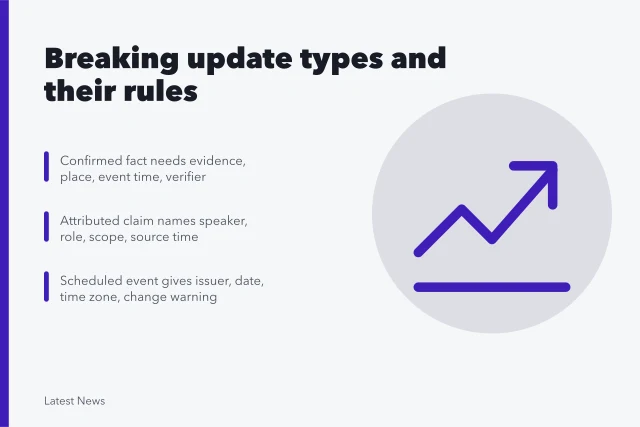
An award notice can establish recipient, amount, period, and proposed scope. It cannot establish that the proposed method worked. Coverage should use future tense and identify the planned deliverables. Live desks maintain the same discipline between claims and outcomes; see breaking update types compared.
Prototype versus deployed system
Report test environment, input, duration, failure rate, power, size, operator skill, safety controls, and comparison. A staged demonstration may answer one engineering question while leaving production and field reliability unresolved. Choosing a container that can carry those caveats is the subject of daily explainer formats compared.
Standard versus law
A voluntary standard can be incorporated into a contract, regulation, code, or procurement requirement. Report the document's issuer, edition, status, scope, adoption path, and effective date. Do not call every technical specification a legal mandate.
Standard to legal mandate
- Voluntary standard issued
- Incorporated into contract
- Incorporated into regulation
- Incorporated into code
- Incorporated into procurement
- Effective date applies
Common questions
Is a conference paper peer reviewed?
Processes vary. Check the venue's stated review method and label it accurately.
Does a DOI mean a paper passed peer review?
No. Repositories, datasets, preprints, and other objects can receive DOIs.
Is a final standard automatically compulsory?
No. Its legal or contractual force depends on adoption and jurisdiction.
Can a press release be cited for a result?
Use it for the fact of the announcement and attributed comments. Use the underlying record for methods and findings.