Guides
Shoot year versus broadcast year versus release year: K-drama's three dates
K-drama actors by year: why shoot year, domestic broadcast and international release are three facts, and how split seasons and remakes break a year field.
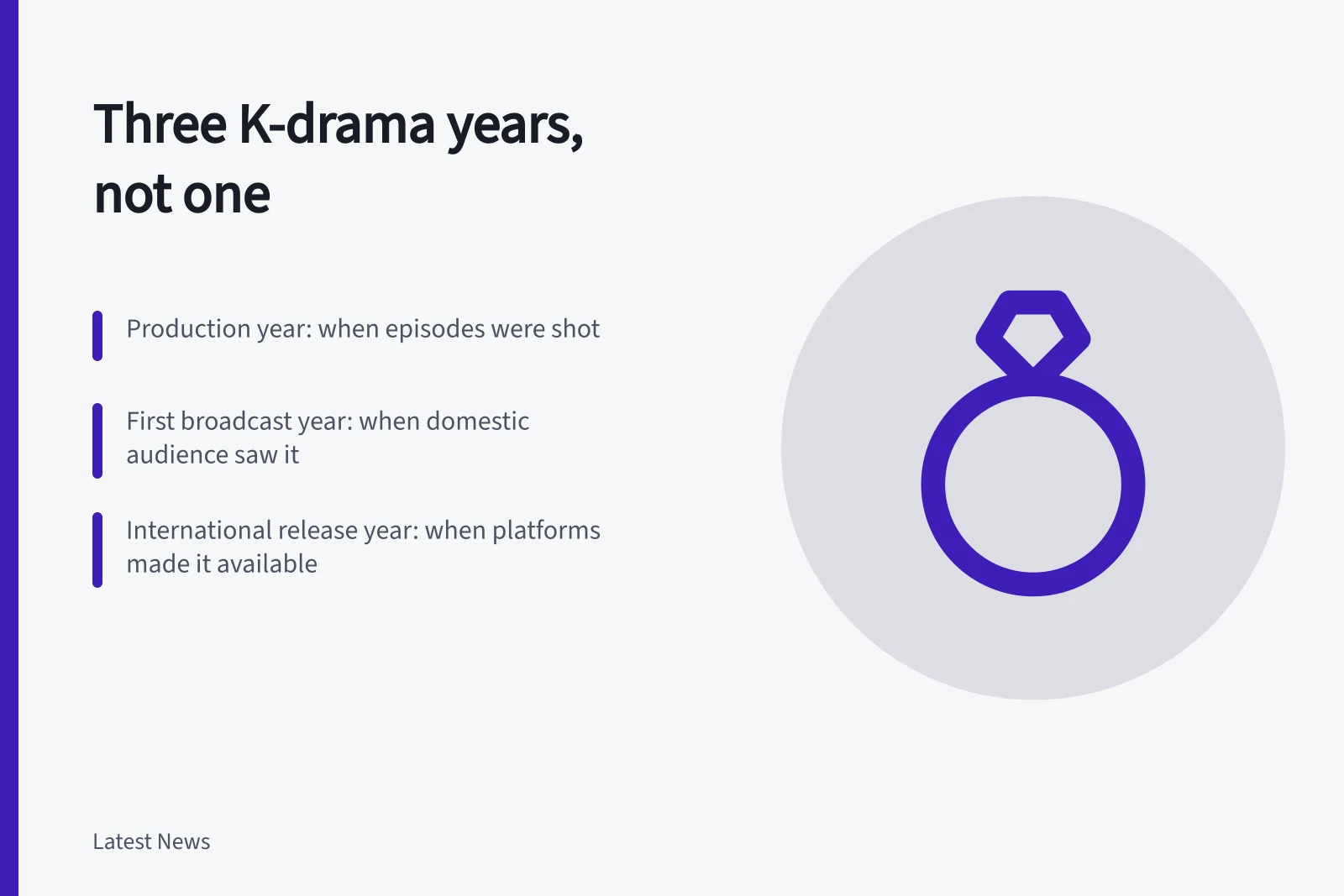
Put Korean drama into a year-by-year index and the years stop lining up almost immediately. A season shot in one year, aired in the next, and released internationally in the one after that has three defensible years, and picking one without saying which is how an index starts lying quietly.
This page is about the year field in that specific context. It names no performer and states nothing about anyone's work.
What to take away
- Shoot year, first broadcast year and international release year are three different facts. Store all three, labeled, and choose which one a query means.
- The gap between them is wider here than in most markets, because international distribution often follows a domestic run rather than accompanying it.
- A year-organized index is a view, not a truth. The stored records should be productions with dates, and the year page should be generated from them.
The three years, and which one answers which question
| Year | What it is | The question it answers |
|---|---|---|
| Production year | When the episodes were shot | When the work was done, which is the performer's year |
| First broadcast or release year | When the domestic audience first saw it | When the production entered public record |
| International release year | When a platform made it available elsewhere | When most non-domestic viewers encountered it |
A directory that stores one number and calls it "year" has silently chosen one of these questions and hidden the choice. The failure is not obvious, because every entry still looks like a fact.
Three years, three questions
Production year
- What it is
- When episodes were shot
- Question answered
- When work was done
Broadcast year
- What it is
- Domestic first viewing
- Question answered
- When public record began
International release year
- What it is
- Platform made it available
- Question answered
- When non-domestic viewers saw
For a record about work, the production year is the honest anchor and the broadcast year is the one everyone else uses. The workable answer is to store both and to label every displayed year with which it is. The general argument for dating productions rather than people runs through why an era belongs to a production.
Why the gap is unusually wide here
Two ordinary features of the market stretch it.
Domestic broadcast runs and international platform releases are always separate events that follow separate schedules. Either one can ultimately come first, depending on how the production was financed.
Some productions are completed well before broadcast, while others are shot close to air. The shoot-to-broadcast gap is not a constant, so you cannot apply it as a rule of thumb.
Which model a given production used is a published fact about that production, and it belongs in the record rather than in an assumption. The two commissioning models and what each leaves in the paperwork are set out in how this production system records itself.
Seasons, parts and the same title again
A title can return as a new season, as a split of one season into parts released months apart, or as a separate production reusing a name. Each of these produces a different correct answer to "what year is this".
Record structure for returning titles
- Production record
- Season record
- Release event record
- Release event carries territory and platform
- Part two sits as release event
The structure that survives is a record for the production, a record for each season, and a record for each release event, with the release event carrying the territory and the platform. A part-two release then sits where it belongs, as a release event of an existing season rather than as a new season.
Get this wrong and every count derived from the index is wrong in a way nobody can find later, which is the same failure that counting episodes rather than storing them produces on the American side.
Remakes are the sharpest case. A format remade in another market is a different production with its own year, its own cast and its own record, related to the original by a link rather than by shared identity.
What a year page can honestly show
A year page built from properly dated productions can show what was first broadcast in that year, what was in production during it, and what became available internationally in it. Those are three lists, and they should be three lists.
It cannot give a ranked or definitive account of who was working. Records are thickest for productions that reached international platforms, thinnest for everything else.
A year page assembled from English-language sources is a picture of what was exported. Treating that as a picture of the industry is textbook sampling bias. Say so on the page, not in a footnote.
Dates in a different calendar and a different alphabet
Two practical traps sit under all of this.
Dates published domestically may appear in a year-month-day order that reads differently to an audience expecting day-month-year, and an ambiguous date in an index is a permanent defect. Store dates in an unambiguous format and record the format the source used.
Titles carry the same problem as names. A production has a Korean title, an official English title, and often a working or literal translation that circulates before the official one is set. Store all of them, marked, so a search on any variant finds the record.
This is the same discipline as keeping every observed romanisation of a name, and it matters for anyone trying to establish how this industry actually hires before spending money on it.
The national library guide to moving image research collections is a useful model for how a serious catalog handles variant titles.
Common questions
Which year should I put on a credit?
The production year if the record is about work, the first broadcast year if the record is about the program. Whichever you choose, label it, and store the other one too.
Why does a series appear under two different years in two indexes?
Almost always because one used domestic broadcast and the other used international availability. Check the definitions before assuming an error.
Are parts of a split season one season or two?
One season, released in two events. Storing them as two seasons corrupts every count that follows from the record.
How do I date a production whose official page is gone?
Look for the broadcaster's archived program page, then national industry bodies, then contemporaneous press. Record what you found and where, and mark the date as sourced from a secondary record. The wider orientation on this market is in the pillar on reading a Korean cast list.