Guides
Part of International events and conflicts: a reporting guide
How to verify a conflict claim before publication
Freeze the original post, date the media, audit the casualty count, and label every claim said, verified, or disputed before publication reaches readers.
What to take away
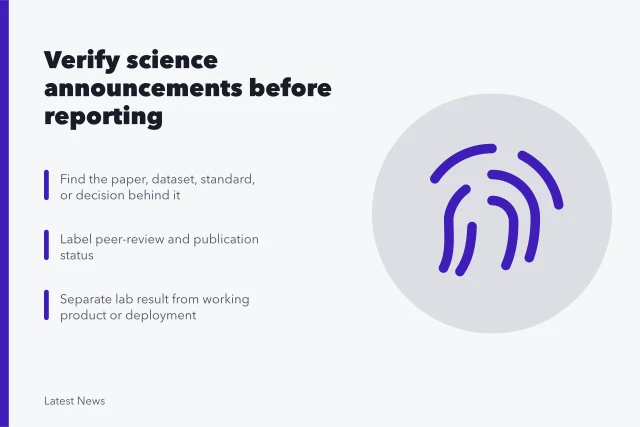
- Save the earliest post, file or statement with its URL, account and timestamp before anyone reposts it.
- Date the media from shadows, weather, road geometry and satellite imagery taken at a known time.
- Ask of any death toll who is counted, what evidence is required, and when the count closes.
- Two outlets repeating one statement are one source chain, not two confirmations.
- Write the status word that matches what you checkedsaid, reported, verified, corroborated, disputed, or could not independently confirm.
Verification is not one badge. A video can be authentic and wrongly dated. A document can be genuine and misread. A witness can describe one street accurately without knowing who acted two blocks away. Work each dimension on its own, and record what you checked. The wider apparatus sits in the international conflict reporting guide.
Photo and credit
The photograph shows a military relief convoy passing damaged buildings in Pago Pago, American Samoa, on October 1, 2009, after the Samoa tsunami. It has nothing to do with armed conflict, which is the point: a caption that carries event, place, date and mission keeps a real image from being read as evidence of something it never showed.
Freeze the origin first
Save the earliest available post, file, document or statement with its URL, account, timestamp and surrounding context. Log reposts separately, because a repost is a new claim with a new timestamp.
Reach the apparent creator through a route you have verified and ask what they saw themselves. The generic fields live in the breaking news verification checklist; conflict claims add the dimensions below.
Date the media
Check file history and metadata when it is safe to open.
The following details apply:
- landmarks
- road geometry
- terrain
- weather
- shadows
- spoken language
- uniforms
- whether the clip has appeared before Compare satellite or map imagery only from a date you can name.
The Human Rights Center at Berkeley publishes the Berkeley Protocol on digital open source investigations, written with the UN human rights office. It sets minimum professional standards for identifying, collecting, preserving, verifying and analyzing open source material. A newsroom is not a legal investigation, but the same order of work keeps findings usable when accounts collide months later.
Build a time window
Keep five clocks apart: capture, event, upload, statement, and your own verification. Visible conditions plus corroborating records give you an earliest and a latest possible capture time. Publish the window, not a single hour you cannot defend.
Audit the count
Brown University's Costs of War project shows on its human costs overview how much the counting method shapes the total. It estimates more than 940,000 people killed by direct post-9/11 war violence through 2023, counts civilians inside that figure separately, and notes that indirect deaths are far larger and harder to establish.
Put four questions to any figure: who is included, what evidence is required, how duplicates are resolved, and when the count closes.
Do not combine hospital admissions, named deaths, missing-person reports and party claims into one total.
Corroborate independently
Look for sources with different access and different incentives:
- local authorities
- medical facilities
- aid agencies
- monitors
- residents
- remote sensing
- official records Two outlets repeating one statement are one source chain. That trap is cataloged in live update problems.
Assess publication harm
Strip names, faces, landmarks, routes, radio details and metadata when they could expose people. Confirm consent and weigh the power imbalance between you and the person giving it. Graphic evidence can be described without being shown.
Write the status
Use "said," "reported," "verified," "corroborated," "disputed" and "could not independently confirm" with precision. Say what you checked rather than claiming total certainty. Status wording carries into the live stream under the rules of the breaking updates and timelines guide.
Common questions
Do two reposts corroborate a claim?
No. Trace both back to their origin, because they may repeat a single source. Corroboration requires a second source with independent access.
Can metadata prove capture time?
It can help, but metadata can be missing, altered, or left on a device's default setting. Combine it with shadows, weather and imagery taken at a known date.
Should graphic images be published to prove harm?
Not automatically. Weigh verification value against dignity, consent, audience need and the risk to anyone identifiable in the frame.
What if the party responsible is unclear?
Describe the verified event, attribute the competing claims to whoever made them, and state plainly that responsibility remains unconfirmed.