Guides
Elections and civic processes: a reporting guide
Election reporting guide to eligibility, registration, ballots, unofficial results, canvass, audits, certification, recounts, finance, courts, and corrections.
What to take away
- Name the election office that controls the contest before you publish a deadline or a document rule.
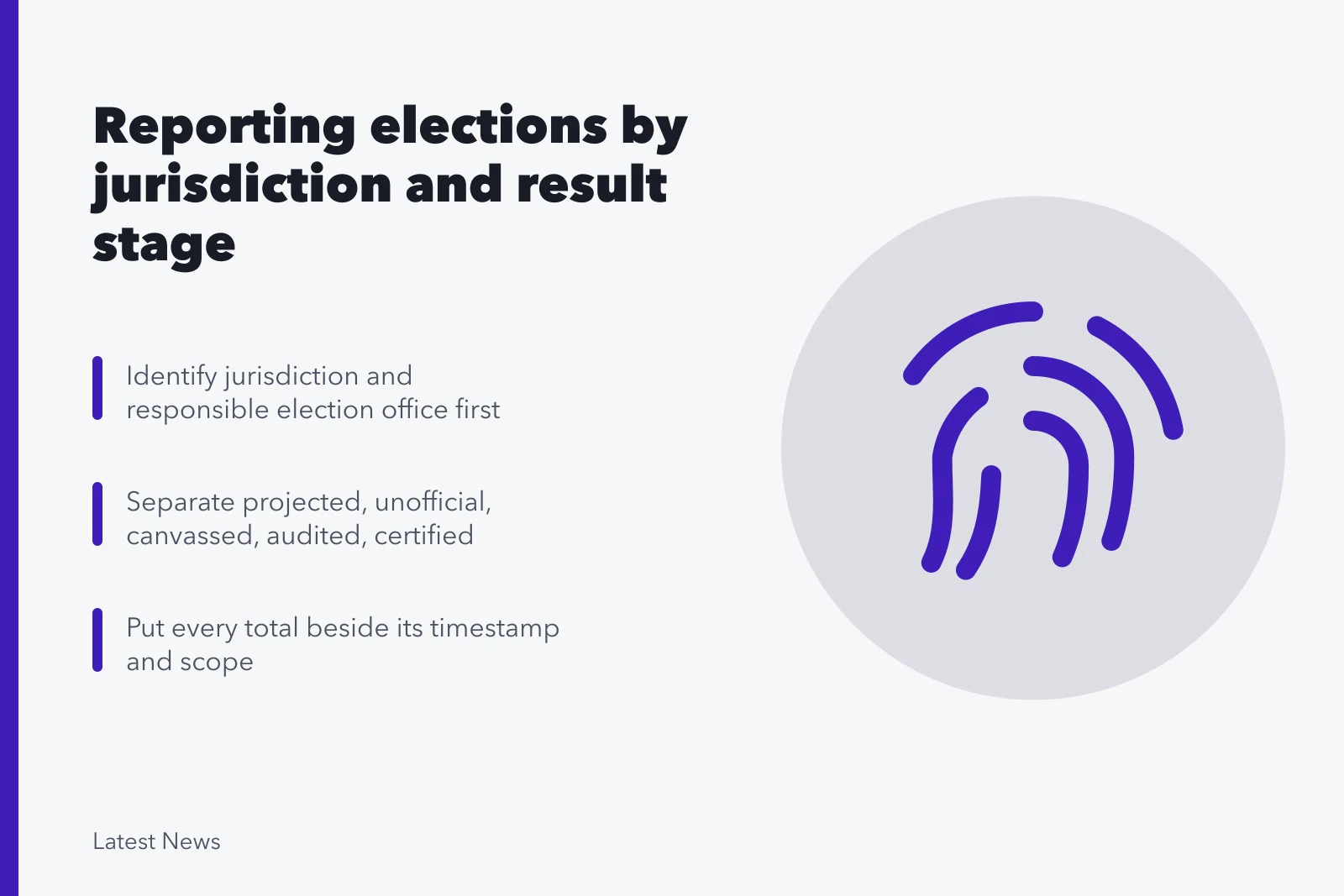
- Label every total by stageprojected, unofficial, canvassed, audited, recounted, certified.
- Put a timestamp and a reporting scope beside each vote count, and say which ballot groups were added.
- Read the filing, the order and the canvass minutes; a campaign statement is not a record.
- Correct a wrong voting instruction on the same page, at the top, the same day.
Election rules and calendars belong to states, counties and courts, not to a national rulebook. An explainer that works names the authority, the stage reached and what a reader can check.
What each jurisdiction card records
Build one card per contest before writing a word. It keeps the article honest when numbers move.
| Field | What to record |
|---|---|
| Contest and jurisdiction | Office, district, election date. |
| Controlling authority | State or county office that certifies the result. |
| Stage | Projected, unofficial, canvassed, audited, recounted, certified. |
| Ballot groups included | Early, mail, provisional, military and overseas, cured. |
| Timestamp and reporting scope | Time of release and units reporting. |
| Next milestone | Canvass, audit, certification date. |
| Worked example | Maricopa County, Arizona, 2024 general election. Contest: county recorder. Authority: county elections department and board of supervisors. Stage: unofficial on election night, then canvassed. Scope: early ballots and Election Day precincts. |
Contest card fields
- Contestoffice, district, measure, party process
- Authoritystate, county, municipality, court, commission
- Calendarregistration, voting, receipt, cure, canvass
- Ballot classesElection Day, early, mail, provisional
- Result statusunofficial, canvassed, audited, certified
- Challengefiling, venue, requested relief, order, deadline
The stage-by-stage machinery of government action is covered in the government decisions and public services guide at latestnews.llc/government-decisions-public-services-guide.
Photo and credit
The photograph shows polling station workers in Cairo during Egypt's 2018 presidential election. It documents that contest only, and nothing about current rules, eligibility, deadlines or results anywhere. It is used here as a generic illustration of polling-station work, not as a US example.
Send voters to the office that runs the election
Eligibility, identification, deadlines, locations and ballot tracking come from the state or county election office. USAGov's voter-registration guide routes readers to those offices for accepted documents and state procedures.
Date every instruction, and keep the exceptions. An online registration deadline can differ from the mail and in-person ones in the same state. When an instruction turns out to be wrong, the repair has its own record: see government decision reporting problems at latestnews.llc/government-decision-reporting-problems.
Report results by stage, not by mood
Election-night totals move as valid ballot groups are processed. Publish votes counted, precinct reporting definitions, the timestamp, and the office's own estimate of ballots remaining. "100 percent precincts reporting" does not mean every eligible ballot is counted.
A media projection is not certification. Attribute it separately from official canvass and certification.
In Maricopa County, Arizona, the elections department posts unofficial results on election night, and the board of supervisors later canvasses the totals.
Sample wording: 'At [time], with [percent] percent of precincts reporting, the office reported [number] votes counted.'
A margin can narrow or widen while counting stays lawful and routine. Say which ballot groups were added between releases rather than computing a remaining estimate yourself. Canvass and certification happen in public meetings, and their records reward the discipline in how to read a public meeting packet at latestnews.llc/read-public-meeting-packet-vote.
Cover disputes from the docket
For a lawsuit, record the court, case number, filing date, and parties. Also record the requested remedy, order, and appeal status. A complaint contains allegations. An order states what the court decided at that stage.
The federal judiciary's overview of how civil cases proceed sets out the sequence: claimed harm and requested relief, discovery, then the plaintiff's burden to prove the case by a preponderance of the evidence.
Election suits run on compressed calendars, but the stages keep their meaning. Say which stage a case has reached.
Read civic records as records
Campaign-finance filings are disclosure documents, not findings. Check committee identity, report period, amendments, transaction type and filing date. A donor with a similar name is not automatically the same person.
For instrument-by-instrument status checks across document types, use government decision documents compared at latestnews.llc/government-decision-documents-compared.
Common questions
Are election-night results final?
No. They are unofficial and can change as valid ballots are processed and post-election procedures run. Report them with the timestamp and the ballot groups included.
Can a media organization certify a winner?
No. Newsrooms project outcomes; certification is an act of the designated election officials on the state's calendar.
Does a filed lawsuit change a result?
Not by itself. Read the requested relief and any later order. A complaint is a set of allegations until a court rules.
Where should voting instructions point?
To the specific page of the state or county election authority that controls the contest. Never to a general article, including this one.