Guides
EPA PFAS Enforcement: How Federal and State Cases Actually Reach Court
EPA's PFAS drinking water rule starts with monitoring. States usually enforce first. Federal court cases arrive when EPA refers a civil action to DOJ.
What to take away
- EPA sets PFAS drinking water limits under the Safe Drinking Water Act, then public water systems must monitor and report.
- States with primacy usually enforce first, while EPA can act if a state does not.
- Federal court cases arrive when EPA refers a civil action to the Department of Justice.
- State attorneys general often sue manufacturers or seek cost recovery rather than prosecute every utility.
- A utility's exposure depends on monitoring results, notice, treatment deadlines, and whether it caused or inherited contamination.
The Rule That Starts a Case
The chain begins with a national drinking water standard. EPA's 2024 PFAS rule sets enforceable maximum contaminant levels for PFOA, PFOS, PFHxS, PFNA, and HFPO-DA, often called GenX. It also uses a hazard index for mixtures of PFBS, PFHxS, PFNA, and GenX.
PFAS overview explains the chemicals and links to drinking water standards and state resources.
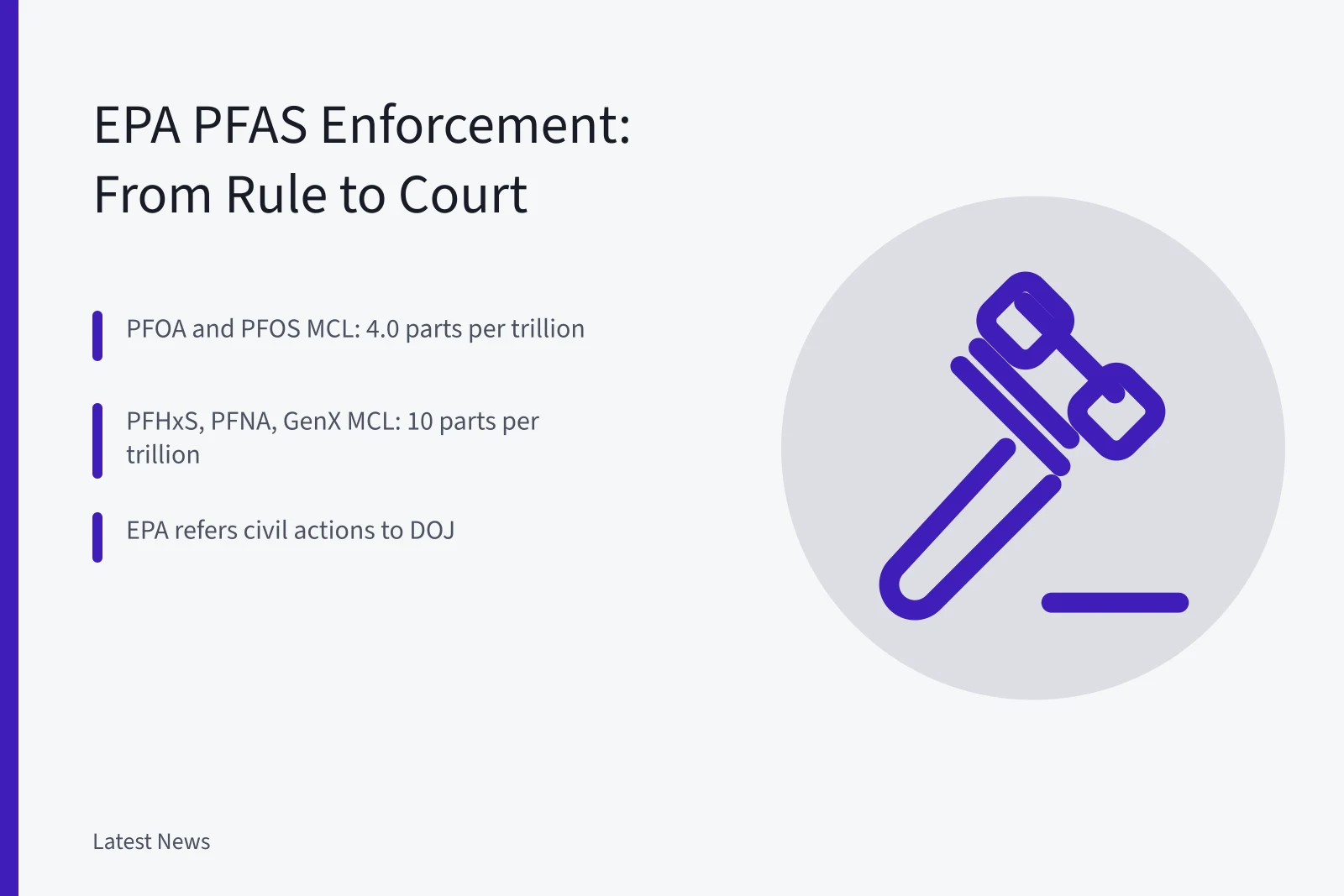
PFOA and PFOS have an MCL of 4.0 parts per trillion. PFHxS, PFNA, and HFPO-DA have an MCL of 10 parts per trillion. The mixture hazard index is 1.0. Systems must complete initial monitoring by 2027 and comply by 2029.
The rule also requires public notice when limits are exceeded. That notice creates a paper trail. It can later support an enforcement case or a utility's request for treatment funds.
drinking water regulations page collects the rule text and state comparison materials.
From MCL to Monitoring
Monitoring turns a legal limit into a fact. A public water system samples finished water, sends results to its primacy agency, and reports to customers.
- Confirm the sample method and lab certification.
- Compare results with each MCL and the hazard index.
- Report exceedances to the state within the required time.
- Issue public notice and plan treatment.
A single result above an MCL does not automatically mean a lawsuit. Agencies often begin with notices of violation, compliance schedules, and administrative orders.
- The primacy agency reviews monitoring data and may issue a notice of violation.
- The agency and utility negotiate a compliance schedule, often with treatment milestones.
- If violations continue, the state may issue an administrative order or seek penalties.
- If the state does not act, EPA may take over enforcement and refer a civil case to DOJ.
Federal Enforcement Channels
The Safe Drinking Water Act gives EPA authority to issue administrative orders and to ask the Attorney General to bring a civil action. The Attorney General's duties and authority over federal investigations are described by the Department of Justice.
In practice, EPA's Office of Enforcement and Compliance Assurance works with the Department of Justice's Environment and Natural Resources Division.
Federal court is not the first stop. EPA can resolve many violations through consent agreements. A judicial referral happens when negotiations fail or when penalties and injunctive relief are needed.
| Stage | Who acts | Typical outcome |
|---|---|---|
| Monitoring | Water system | Sample results and reports |
| Notice of violation | State primacy agency or EPA | Compliance schedule |
| Administrative order | State or EPA | Penalties and required fixes |
| Civil referral | EPA to DOJ | Federal lawsuit or consent decree |
| State AG suit | State attorney general | Damages, injunctions, cost recovery |
The table shows a split channel. A utility faces a regulatory case. A manufacturer may face a damages case brought by a state attorney general.
State Attorney General Cases
State attorneys general often pursue PFAS manufacturers for contamination that reaches drinking water. They may seek natural resource damages, cleanup costs, or consumer protection penalties.
These suits are not the same as EPA enforcement. A state AG can sue under state law, while EPA enforces federal rules. The two can overlap when a state also has primacy.
For a state-by-state view of limits, Michigan, New Jersey, and New York have their own MCLs and testing deadlines. The comparison in PFAS Drinking Water Limits by State tracks those differences against the EPA standard.
A state AG may also defend a state agency's permit decision. That puts the office on the other side of a utility or an environmental group.
PFAS Liability for Water Utilities
Utilities are usually the regulated party, not the polluter. Their liability often turns on whether they missed monitoring, failed to notify customers, or missed a treatment deadline.
Some utilities face claims that they knew about contamination and delayed action. Others seek cost recovery from chemical makers. The legal theory matters because it decides who pays.
A utility can reduce risk by documenting sampling, keeping lab records, and issuing timely notices. A compliance file becomes evidence in any later case.
A drinking water violation is a regulatory problem first. A toxic tort or cost recovery claim is a separate fight over money and responsibility.
Example: A Small System Exceeds PFOS
Suppose a small system finds PFOS at 8 parts per trillion, above the 4.0 ppt MCL. The state primacy agency issues a notice of violation and sets a schedule.
The utility samples again, publishes notice, and evaluates treatment. If it misses milestones, the state can issue an administrative order.
If the state does not enforce, EPA may refer the matter to DOJ. The utility could also sue a manufacturer to recover treatment costs.
Court Review and Remedies
Courts review the agency record, the rule's application, and the remedy. A judge may approve a consent decree, order compliance, or assess civil penalties.
Federal and state cases can run at the same time. A manufacturer may be in state court while a utility is in federal administrative proceedings.
The independent prosecutor model is different from an EPA referral. Special Counsel vs Attorney General explains appointment, scope, removal, and reporting for federal investigations.
That contrast matters because EPA enforcement is a civil regulatory process. A special counsel inquiry is a federal investigation with separate rules.