Rules
Part of Election reporting guide: authorities, stages, records
Election reporting problems: counts, audits and claims
Election reporting problems explained: why counts change after election night, what "100 percent precincts" means, and how audits, recounts and claims differ.
Every election cycle brings the same election reporting problems: totals that shift after election night, a "100 percent of precincts" figure read as a vote count, and four separate procedures — audit, recount, canvass and certification — treated as one. This explainer walks through what each number, label and filing actually means, and what to check before repeating a claim about a result, a recount or a donor.
What to take away
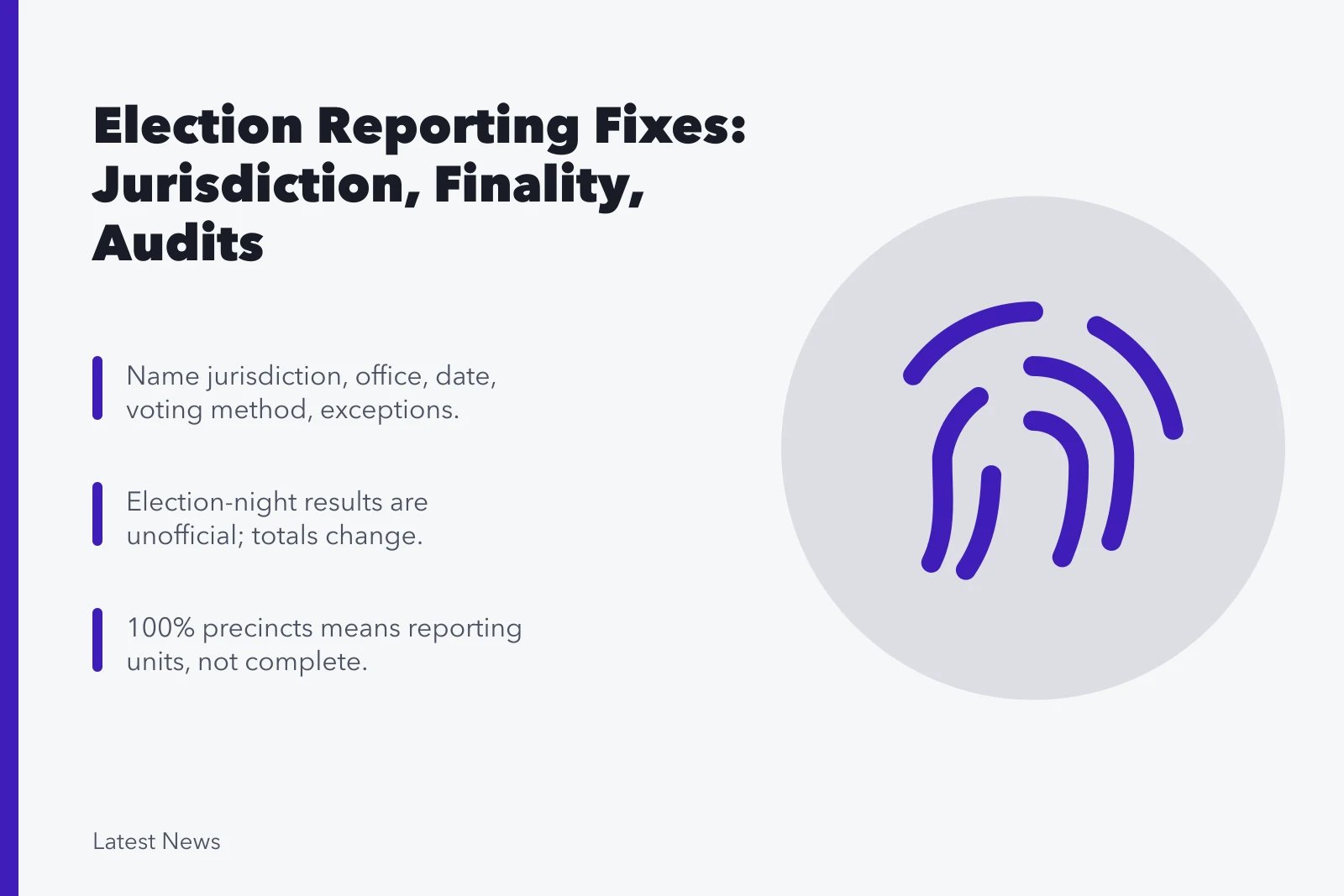
- Name the jurisdiction, office, date and voting method before stating any rule.
- Election-night totals are unofficial; later counts change them by design.
- A precinct percentage counts reporting units that transmitted, nothing more.
- Audit, recount, canvass and certification are four different procedures.
- A name match in campaign-finance data is not an identification.
One rule, many jurisdictions
State law, not a national standard, sets how ballots are cast, counted and challenged. A rule that holds in one county can be wrong in the next one over. In most states the chief election official is the secretary of state, while Wisconsin runs elections through its Elections Commission. The casting, counting and challenging rules sit in each state's own code — the California Elections Code and the Texas Election Code are examples — while federal law sets only floors: the Help America Vote Act of 2002 created the EAC and set minimum standards, and the Uniformed and Overseas Citizens Absentee Voting Act governs military and overseas ballots.
Name the jurisdiction, the office, the date and the voting method, then link the controlling page and timestamp it. Jurisdiction-first framing is the spine of the elections and civic processes guide.
Why totals move after election night
Election-night results are unofficial. The EAC's explanation of post-election result changes, titled "Why do election results change after election night?", describes the mail, provisional, military and overseas ballots, canvass, audit and certification work that follows.
Why Totals Move After Election Night
- Election night: unofficial results
- Mail, provisional, military, overseas ballots
- Canvass
- Audit
- Certification
Treat each official release as a new version. Compare its timestamp, the ballot groups it includes, the contest total and the office's notes against the prior release. When the margin moves, explain which records were newly processed before reaching for political meaning.
Never present a newsroom projection as an official estimate of outstanding ballots. If the election office issues an estimate, give the office, the publication time, the categories covered and the uncertainty it states.
What 100 percent precincts actually measures
Read the site's reporting-unit definition before quoting its percentage. The number answers one narrow question: how many reporting units have transmitted anything at all.
It does not say those units included every ballot class, and it says nothing about central counts that never belonged to a precinct file. In a state where mail ballots postmarked by Election Day may arrive afterward, a 100 percent precinct figure on election night still excludes ballots the law says must be counted. Report the office's outstanding-ballot estimate as a separate figure, and drop the percentage entirely when the definition cannot be found.
Audit, recount, canvass, certification: four different things
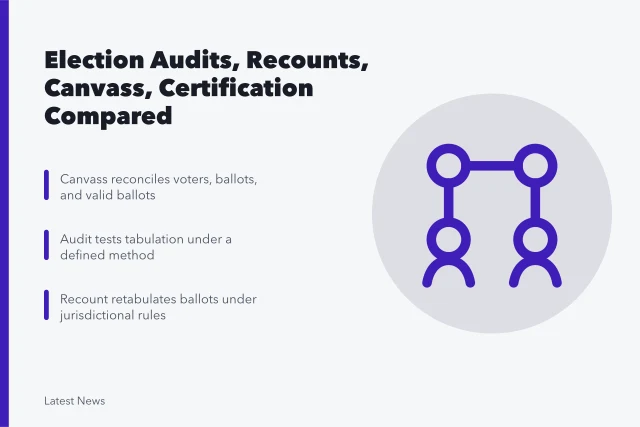
Ask the election office which rule authorizes the process, and quote that rule's own name for it. The same word can mean a hand tally of a sample in one state and a full machine retabulation in another, and that difference decides whether the official result can move. Put the question plainly: is this a risk-limiting audit, a margin-triggered recount, the county canvass or the state certification vote, and which section of the state election code authorizes it?
For each procedure, record six facts before writing:
Four different things
- Purpose, in the authorizing rule's words.
- Legal trigger and who may request it.
- Scopesample, contest or full jurisdiction.
- Authority running it and reporting it.
- Whether the official result can change.
- Citation, kept in the story file even when not printed.
The purpose-by-purpose comparison is in election audits recounts canvass and certification compared.
A donor name is not an identity
Search committee IDs — they begin with C — along with report periods, employer, occupation, location and transaction type. Filings arrive on named forms: Form 1 for a committee's statement of organization, Form 3 for House and Senate campaign committees, Form 3X for party and political action committees, Form 5 for independent expenditures and Form 6 for 48-hour notices. The FEC browse-data guide separates filings, reports, bulk data, receipts, spending and loans.
A name match alone proves nothing. Two entries can share a name and belong to different people, and amendments routinely restate earlier figures.
A complaint is not a court finding
Describe allegations and requested relief as claims by the filer. Then read later orders and explain their exact effect.
Keep the procedural posture visible. An order can deny relief without deciding any fact, grant a pause without finding an error, or resolve one count of several. Say which question the court answered and which it left open. The Supreme Court's order in Bush v. Gore halted the Florida recount in 2000 and said its holding was limited to the circumstances of that case, not a finding that any ballot had been miscounted. Government coverage repeats these traps; see government decision reporting problems.
When the correction is the story
Wrong voting instructions require replacement across headline, story, graphic, alert, newsletter and social post. Add a correction note and tell partners who repeated the error. Wire services handle it the same way: The Associated Press sends a corrective, a replacement story that supersedes the original on the wire.
Then check the correction the way the original should have been checked: against the controlling page, with jurisdiction, date and voting method attached. The full pre-publication sweep is the election reporting checklist.
Common questions
The questions below come up most often when counts change, margins narrow and records are cited.
Why can valid results change after election night?
Officials keep processing eligible ballot groups and reconciling counts under state law. The EAC's "Why do election results change after election night?" explains the sequence, and the Uniformed and Overseas Citizens Absentee Voting Act is one reason military and overseas ballots can arrive after election night.
Is a close margin proof of error?
No. A close margin may trigger a recount or audit under state rules, but the margin alone shows no error.
Can campaign-finance records identify a person conclusively?
Not always. Similar names, missing employer fields and amended reports mean a match needs corroboration beyond the name.
Does filing a case stop certification?
Only if state law or a court order says so. Read the order's operative language rather than the filing.