Rules
Part of International events and conflicts: a reporting guide
International conflict reporting problems and fixes
Conflict reporting fixes for unattributed claims, recycled media, casualty totals, legal overreach, false balance, map certainty, document confusion, and risk.
What to take away
- Put attribution beside each contested fact.
- Trace media to origin before using it as evidence.
- Publish casualty methodology with the figure.
- Keep legal analysis separate from factual verification.
- Do not expose a source merely to make verification look transparent.
Problem: a party claim becomes narrator voice
Fix
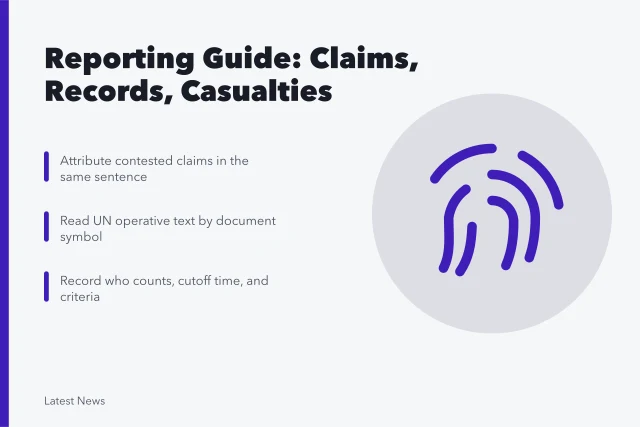
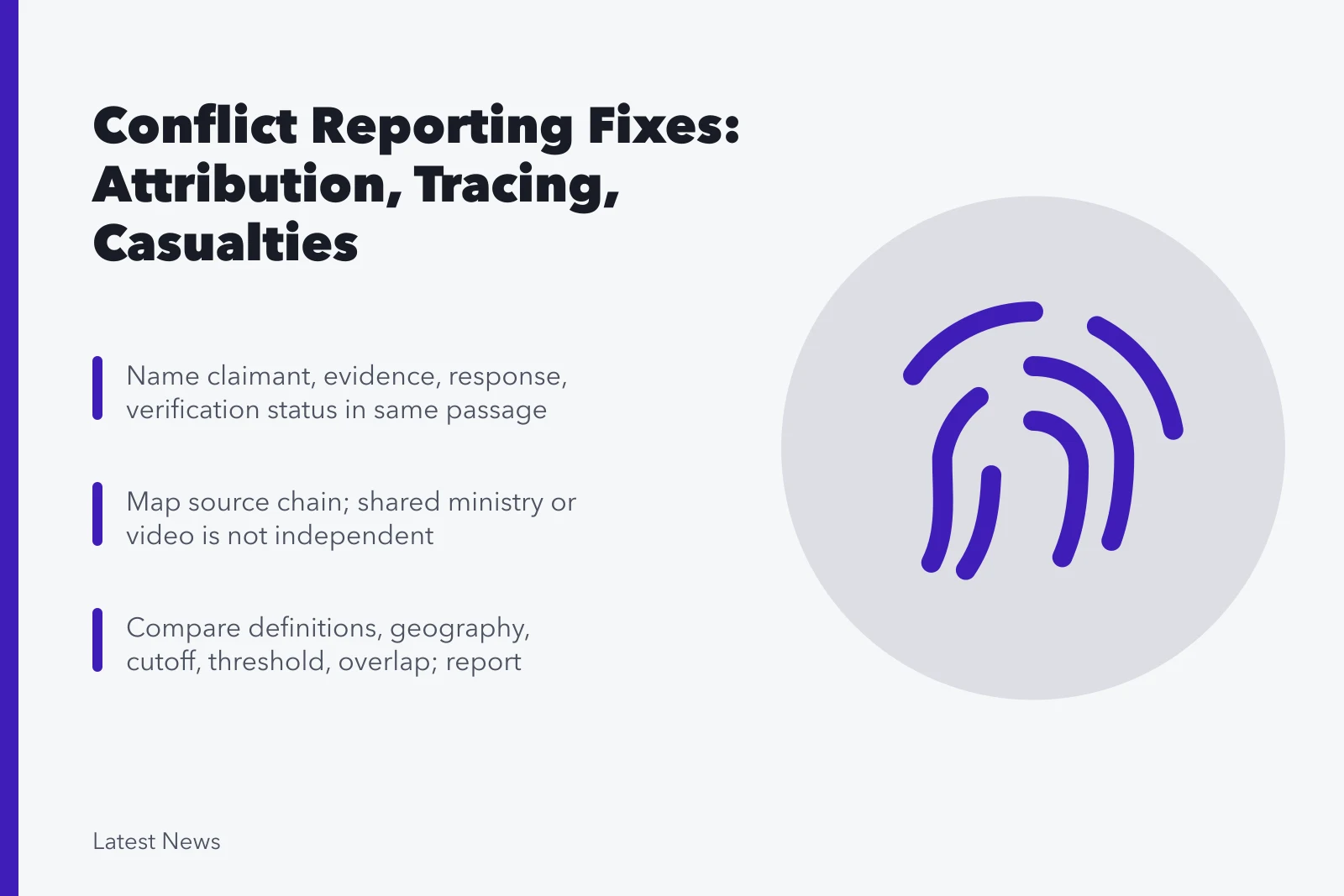
Name the claimant, evidence offered, response from other parties, and newsroom verification status in the same passage. Avoid vague phrases such as "it is understood." Attribution mechanics are set out in the international conflict reporting guide.
Attribution checklist
- Name the claimant
- Evidence offered
- Response from other parties
- Newsroom verification status
- Avoid 'it is understood'
Problem: two reports become two confirmations
Fix
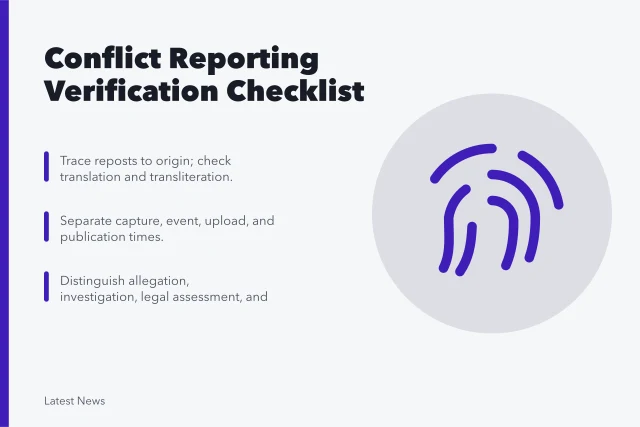
Map the source chain. If both reports cite one ministry, witness, or video, they are not independent. Seek a source with different access or evidence. The tracing steps are in how to verify a conflict claim.
Trace the source chain
- Report A cites ministry
- Report B cites same ministry
- Not independent
- Seek different access or evidence
Problem: casualty figures are stacked
Fix
Compare definitions, geography, cutoff, verification threshold, and overlap. Report ranges or separate estimates when methods differ. Do not average them.
State each figure's counting unit as part of the attribution. A tally of verified named deaths, a hospital's reported admissions, and a model's excess-mortality estimate answer three different questions, and the smallest is not automatically the most careful nor the largest the most inflated. The method note is what lets readers compare.
Problem: a legal conclusion outruns the record
Fix
Describe the verified conduct, cite the relevant rule, attribute allegations, and seek legal expertise. The ICRC's rules-of-war FAQ explains protections for civilians and others not taking part in fighting and outlines distinction, proportionality, and precaution. Applying those rules to a specific event still requires facts and legal analysis.
Separate conflict classification from the incident question. Identify which treaty or customary rule the analyst relies on and whether the conclusion depends on disputed facts. A term used in political speech may have a narrower legal definition.
Do not infer intent from outcome alone unless the applicable rule and evidence support that step. Preserve the difference between a possible violation, a documented pattern, an official investigation, a charging decision, and a final judgment. Courts and investigative bodies can also have limited jurisdiction, so name the institution and scope.
When experts disagree, show the factual or legal premise behind the disagreement. Listing titles without their reasoning does not help readers evaluate the claim.
Problem: a press statement becomes a resolution
Fix
Find the document symbol, text, meeting record, and vote. The UN Security Council resolutions index explains that resolutions have a preamble and operative part and lists adopted texts by year. Read the operative paragraphs before stating what the Council decided.
Problem: maps look more certain than evidence
Fix
Date every boundary, identify the method, and show disputed or uncertain areas. Do not infer control from one checkpoint, post, or absence of footage.
Date the underlying observations, not only the map's publication. A boundary drawn from last week's imagery is a claim about last week. Weather desks fight the same display traps; see weather disaster reporting problems.
Problem: transparency exposes people
Fix
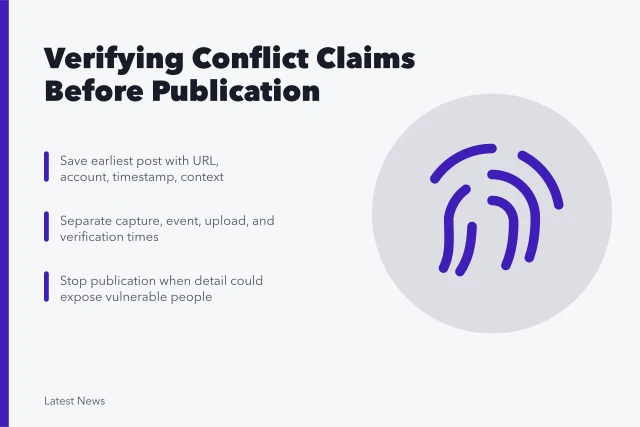
Explain verification steps without publishing precise shelters, routes, medical sites, witness identities, or metadata that raises danger. Store sensitive evidence with restricted access. The harm-review items in the international conflict reporting checklist make this a standing gate.
Problem: balance replaces evidence
Fix
Include relevant responses, but do not give unsupported claims equal weight. Tell readers what each side says and what evidence independently supports.
Common questions
Is "both sides say" enough attribution?
No. Name the parties and attach each claim to its source.
Can casualty figures be called confirmed?
Only under a stated verification process. Explain who confirmed them and how.
Does citing a rule prove a violation?
No. The event facts, legal framework, intent where relevant, and competent assessment matter.
Should a source's face be blurred?
Sometimes, but blur alone may not protect identity. Voice, surroundings, metadata, timing, and narrative details can also expose a person.