Features
Part of Election reporting guide: authorities, stages, records
Case study: a fictional close local election
A close election reporting case study follows a fictional Lake County race through election-night totals, canvass, audit, certification, and recount.
What to take away
- Election-night totals are unofficial until a canvassing board certifies them.
- "100 percent of precincts" never means every ballot is counted.
- Each margin belongs to a named stage and a date, not to a running total.
- An audit tests tabulation under a defined sample; a recount retabulates ballots under a legal trigger.
- A filed complaint is not a court finding.
This close election reporting case study follows a fictional Lake County race. At 11:30 p.m., Candidate A leads by 84 votes in a fictional county executive contest. The results page says 100 percent of precincts reported and lists mail and provisional processing through Friday. No real candidate, county, result or rule appears here.
Election night
The desk records the page time, the vote totals, the result status, the reporting-unit definition and the next update. The headline says Candidate A leads in unofficial results. It does not say all ballots are counted or declare a winner. The stage labels follow the elections and civic processes guide.
The desk saves the results page with its timestamp as the version of record for that hour. Lake County counts a precinct as reported when its election-day file arrives.
So the story quotes "100 percent of precincts" only with a note that mail and provisional ballots remain in process. Capturing the page this way follows how to read an election results page.
The U.S. Election Assistance Commission (EAC) publishes a guide to election administration describing a decentralized system in which state and local rules govern deadlines and authority. The fictional story relies on Lake County's fictional rules for both.
Friday update
The county adds 1,200 eligible mail ballots and 90 provisional ballots. Candidate B now leads by 22. The story names which categories were added and drops the old 84-vote lead from the headline. A county estimate puts 140 ballots under review as of 4 p.m.; the article does not call that number exact.
Margin by stage
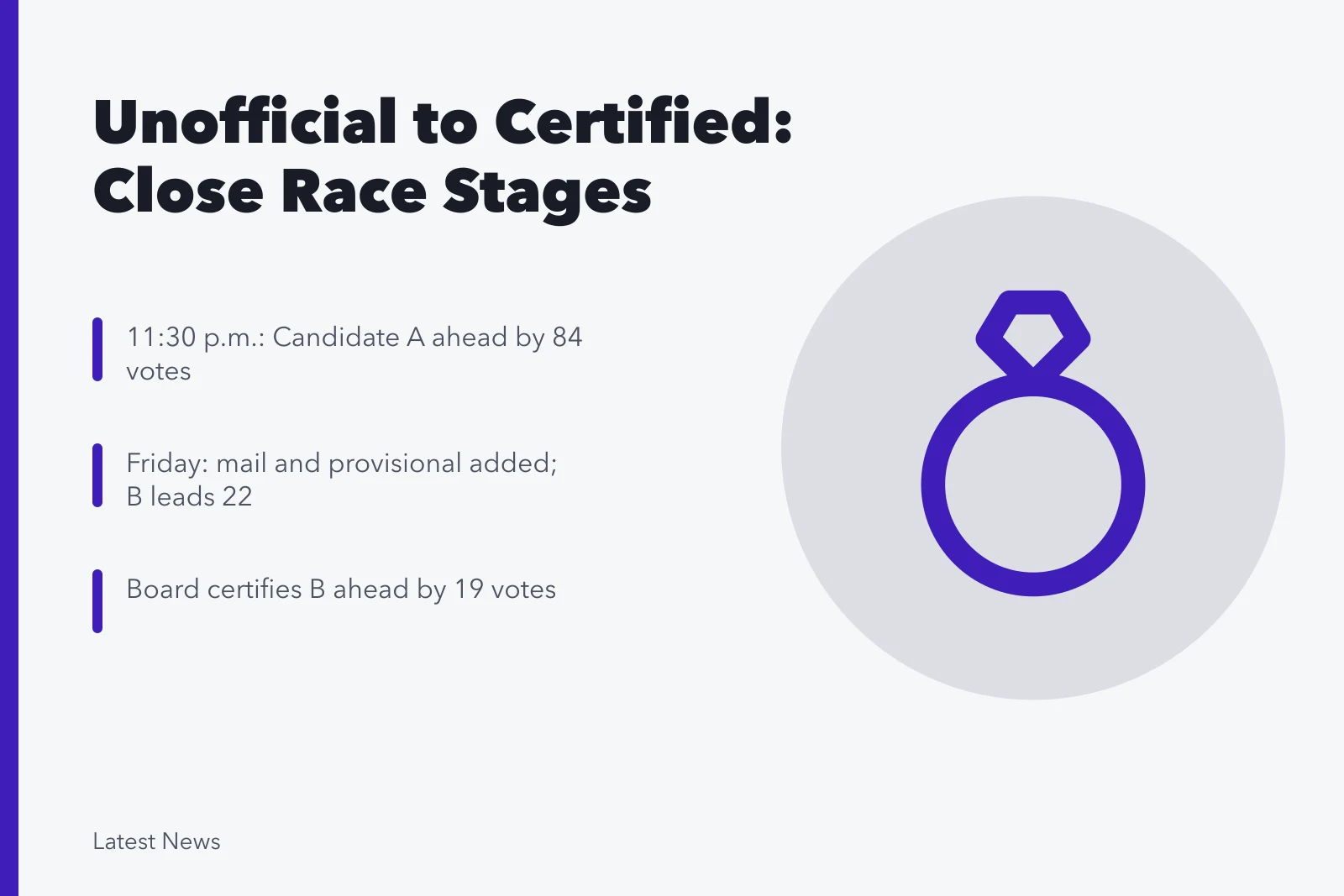
- Election nightA +84
- Friday countB +22
- CertificationB +19
- RecountB +17
Each update keeps a ledger visible: ballot groups added, the new margin, the office's outstanding estimate, and the time of each figure. A reader who left on election night can reconstruct the change without inferring anything.
| Stage | Margin | Date | Status |
|---|---|---|---|
| Election night | A +84 | Nov 4, 11:30 p.m. | Unofficial |
| Friday count | B +22 | Nov 7, 4 p.m. | Unofficial |
| Certification | B +19 | Nov 21 | Official record |
| Recount | B +17 | Dec 9 | Awaiting confirmation |
Canvass and audit
The canvassing board reconciles voter and ballot records. A required tabulation audit samples specified batches and finds no discrepancy. The story does not call this a recount. It reports the method, sample and conclusion the board supplied.
When a reader asks why the audit did not simply recount everything, the story answers in one sentence.
The audit tested tabulation under its defined sample, while a recount would retabulate covered ballots under a separate legal trigger. See election audits recounts canvass and certification compared.
Certification
The board certifies Candidate B ahead by 19 votes. The headline changes to certified result. A candidate then requests a recount under the fictional close-margin rule. In real reporting, the desk would name the state election code section that sets the recount trigger (typically a margin threshold below a statutory percentage), identify the county board of elections or registrar that receives the filing, and cite the form the candidate must submit.
The U.S. Election Assistance Commission's Recount Quick-Start Guide notes that recounts follow state law and require planning, ballot security, observers, and finalization procedures. The desk reports the fictional order, scope, schedule, and authority instead of predicting the result.
Recount and court filing
The recount changes two ballot interpretations and leaves Candidate B ahead by 17. Candidate A files a complaint seeking review of one ballot category. The article says a complaint was filed and summarizes the requested relief. It does not say a court found error.
Four margins have now existed, and the desk resists blending them. Each figure belongs to a named stage with a date. The fictional border closure case applies the same dated-stages discipline to a conflict story.
Common questions
These questions track the fictional Lake County scenario and point toward the real authorities a reader should consult.
Is Lake County real in this case?
No. Every candidate, county, margin and rule in this scenario is invented to show the reporting sequence. Use it as a checklist for real coverage, not as a record of any contest.
Why did the lead change?
Additional eligible ballot groups were processed under the fictional schedule. Mail and provisional ballots are counted after election night in most jurisdictions, so an early lead can narrow or reverse as those groups are added.
Did the audit guarantee no error existed?
No. It produced a result under its defined method and sample. An audit that finds no discrepancy in sampled batches tells you those batches matched; it does not certify the whole count.
Was the certified result final after a recount request?
The certified result remained the official record at that stage, subject to the fictional recount and legal process. Check the state election office for how a recount request affects certification where you report.