Rules
Part of Science and technology announcements: a reporting guide
Science and technology reporting problems and fixes
Announcement coverage fails when a proposal reads as a result, so label status, compare like with like, and track versions after publication.
What to take away
- Name the document status in the headline or opening lineproposal, draft, preprint, approved standard, or adopted requirement.
- Replace promotional adjectives with the measured difference, the test conditions, and the uncertainty.
- A passed test, a launch, and an operating system are three different milestones. Name the gate that closed and what remains.
- State who funded the work and under which program. Money is not endorsement unless the funder says so.
- Record identifiers and dates, then revisit the article when the record changes.
Most announcement coverage fails the same way: a proposal is written as a result, a test as a product, a draft as a rule. Each fix below restores the missing status. The status vocabulary comes from the science announcement reporting guide.
Preprints and unpublished papers
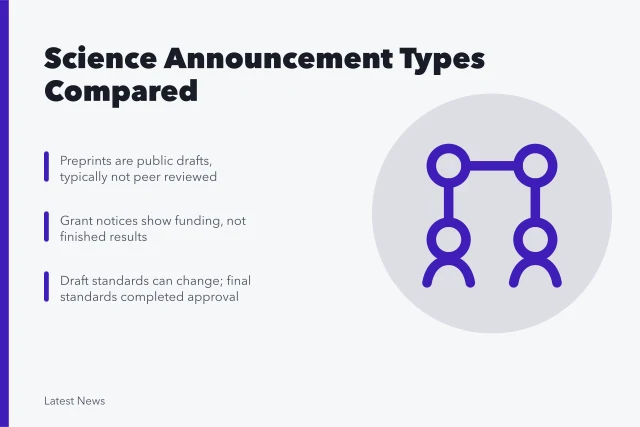
Open the repository and journal records before writing. State the version number and posting date, then say plainly whether the paper has been peer reviewed. Assess the methods with the same care you would give a published paper. The full status table sits in science announcement types compared.
Preprint status check
- Open repository and journal records
- State version number and posting date
- Say if peer reviewed
- Assess methods as published paper
Release adjectives with no comparison
Words like unprecedented and game-changing arrive in the release and move straight into the headline. Ask what the comparison is against. Replace the adjective with a measured difference, the conditions the measurement was taken under, and the uncertainty attached to it. If the announcement claims a first, define the field and search earlier work before repeating it.
Handling release adjectives
Does the adjective have a comparison?
Replace with measured difference
Ask what it is against
Draft standards and how to check status
Work through the sequence rather than trusting the announcement's verb.
NIST FIPS development stages
- 1Draft notices
- 2Public input
- 3Approval
- 4Final publication
- 5Periodic review
- 6Withdrawal
- Find the document statusproposal, draft, public comment, approved, published, or withdrawn.
- Note the comment period and the body that approves the text.
- Record the publication date, then the separate adoption and effective dates.
- Read the scope and definitions before summarizing any technical requirement.
- Ask how conformance is shownself-declared, laboratory tested, certified elsewhere, or unaddressed.
NIST's FIPS development procedure sets out several stages:
- draft notices
- public input
- approval
- final publication
- periodic review
- withdrawalThat sequence is why a proposal, a draft, an approved standard, and an adopted requirement need separate words.
A standard can apply only to federal systems, one product class, or a defined test method. When an organization says it complies, ask for the edition, the profile, the test report, and who assessed it.
A comment deadline is news about participation, not evidence the draft survives unchanged. When the final text lands, compare it with the draft and report material changes.
Check separately whether a regulator, procurement office, contract, or code adopts it, because publication and legal effect can fall on different dates.
Milestones that are not mission success
Entering design, finishing assembly, launching, and beginning operations are four different achievements. Name the gate that closed and what remains open. NASA's mission phase definitions separate final design and fabrication, assembly and test, launch and checkout, and operations and sustainment. Use the project's own plan, but keep development status distinct from operating status.
Benchmarks and real-world performance
Report the benchmark, the hardware, the dataset, and the tuning. Report the baseline, the repetitions, and the error bars. Ask whether both sides ran on equal resources and whether an independent group reproduced the number. Do not extend the claim past the tested workload.
If the claim survives those questions, publish the margin with its conditions attached. If the conditions are missing, say the comparison could not be evaluated. Both are results a reader can use. Data-release coverage meets the same category errors, as economic release reporting problems sets out.
Funding is not endorsement
State who provided the money and under which program. Keep the authors responsible for their conclusions unless the funder expressly adopts them. List company roles and relevant patents.
When the record changes after publication
Record identifiers and dates when you file. Then watch preprint revisions, paper corrections, dataset releases, and software versions. Also watch standard drafts and mission status. Rewrite the prominent conclusion when the underlying record moves. The science announcement reporting checklist builds that monitoring into the publication routine.
Common questions
Can a preprint be newsworthy?
Yes. Label its status, read the methods, seek independent review, and avoid implying journal approval. The label belongs in the headline, not the eighth paragraph.
Does a launch mean a mission is operational?
Not automatically. Checkout, commissioning, validation, and the transition to operations may all follow. Name the phase the project itself reports.
Is a final standard a law?
Not by itself. Check whether a jurisdiction, regulator, contract, or organization adopted it, and on what date. Publication and legal effect are separate events.
What gets corrected first?
Wrong publication status, wrong result, wrong comparison, safety implication, or availability claim. Style comes last.