Maintenance
Part of International events and conflicts: a reporting guide
International conflict reporting checklist
Conflict checklist for attribution, source chains, location, timing, casualty methods, legal labels, displacement, official records, publication harm, and updates.
What to take away
- Check every contested claim for attribution and source basis.
- Preserve event, capture, upload, and statement times.
- Do not merge casualty figures with different methods.
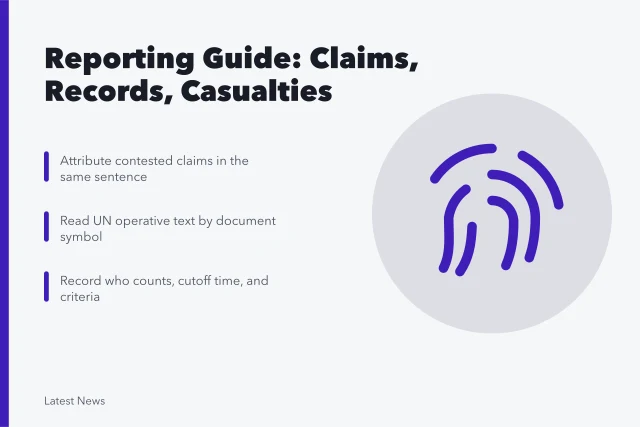
- Verify official documents by symbol, vote, and operative text.
- Conduct a harm review before naming people or places.
Claim and source
- The narrow claim is written separately.
- The claimant and direct observer are distinguished.
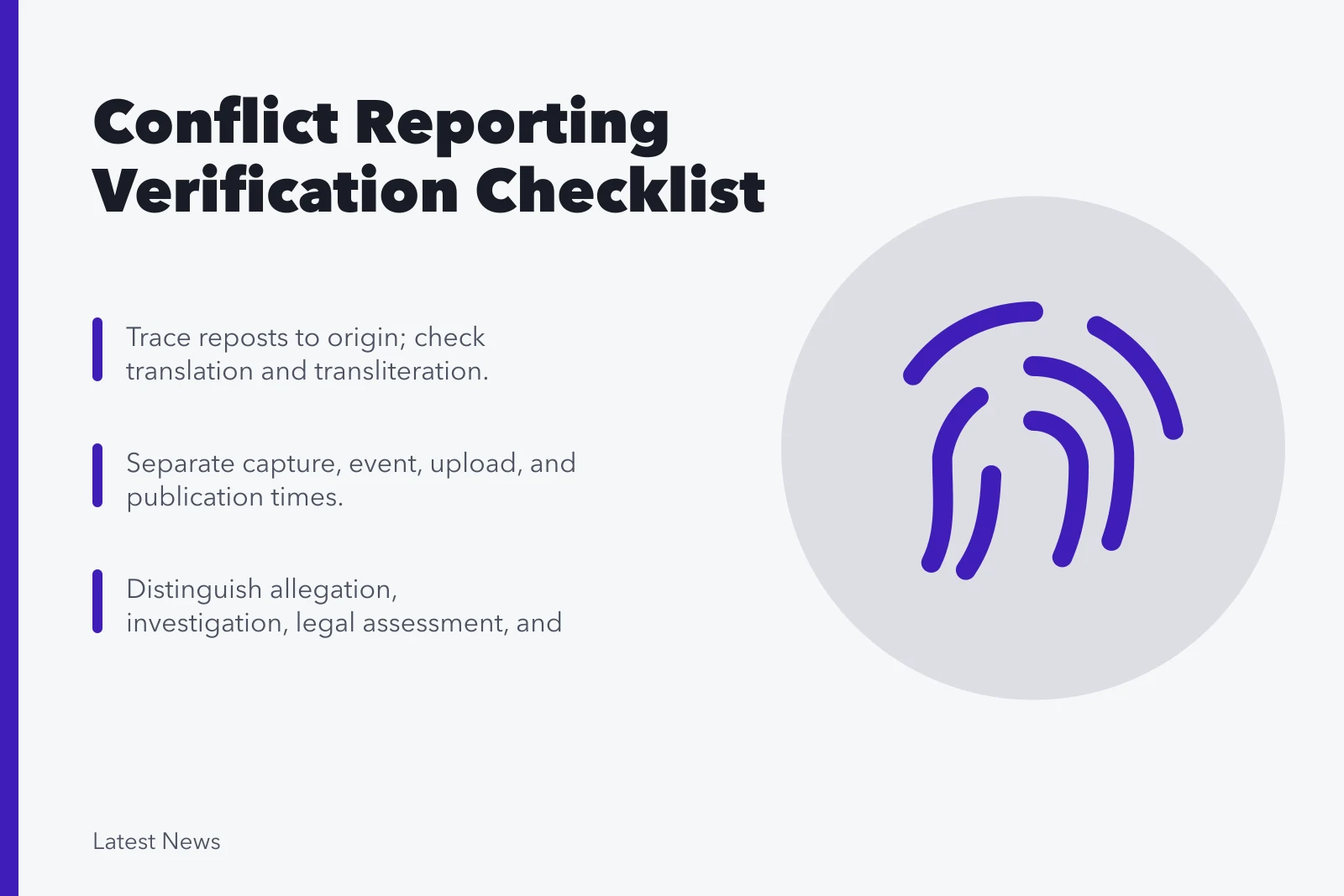
- Reposts are traced to origin.
- Translation and transliteration were checked.
- Party affiliation and relevant interests are stated.
The parent international conflict reporting guide explains the ledger these items feed.
Claim and source checks
- Narrow claim written separately
- Claimant and direct observer distinguished
- Reposts traced to origin
- Translation and transliteration checked
- Party affiliation and interests stated
Place and time
- Country, region, locality, and coordinates are consistent.
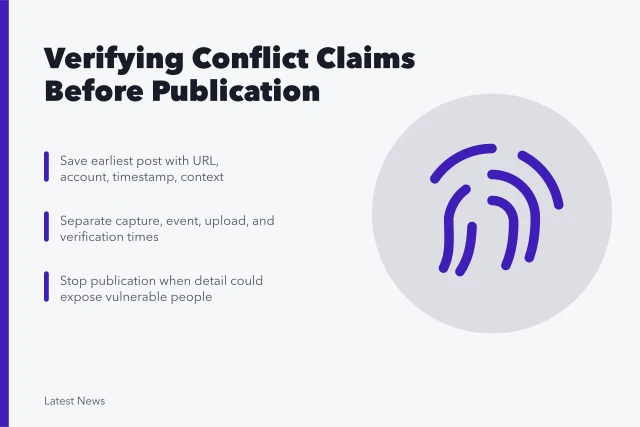
- Capture, event, upload, and publication times are separated.
- Map boundaries and control claims have dates.
- Tactical or shelter locations are withheld when harmful.
For officially issued alerts inside the same story, the public safety alert reporting checklist adds the sender and scope fields.
Place and time checks
- Country, region, locality, coordinates consistent
- Capture, event, upload, publication times separated
- Map boundaries and control claims dated
- Tactical or shelter locations withheld when harmful
Civilian harm and law
- Counts include source, method, cutoff, area, and category.
- Missing, injured, killed, detained, and displaced are not merged.
- Civilian status is not inferred from appearance alone.
- Allegation, investigation, legal assessment, and judgment are distinct.
The ICRC's overview of conduct-of-hostilities rules explains the principles of distinction, proportionality, and precautions and stresses assessment based on information reasonably available at the time. A report should describe evidence and obtain qualified analysis rather than pronounce a final legal conclusion from one image.
Same restraint applies to patterns: a run of verified incidents can support reporting that a pattern exists, but the step from pattern to legal finding still needs the analyst, the rule, and the facts on the record. State plainly which of those steps the article takes.
Readers can accept an unfinished conclusion, but they cannot recover from a wrong one presented as final. Underlying claims still clear the breaking news verification checklist first.
- The article states which facts support the legal discussion.
- The analyst's jurisdictional assumptions are visible.
- Contested civilian or military-object labels are attributed.
- A party's internal review is not called an independent judgment.
Displacement and humanitarian access
- People, households, movements, registrations, and estimates are not mixed.
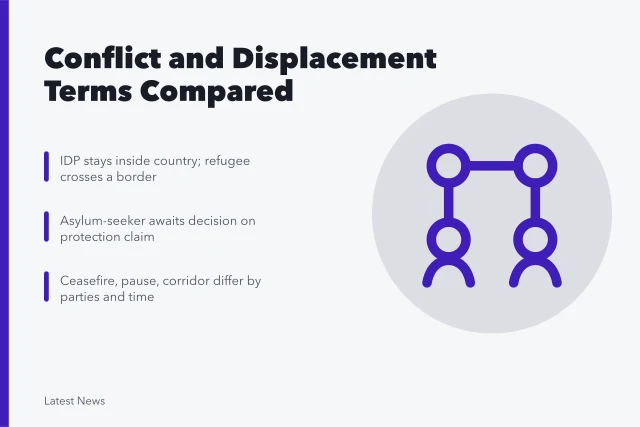
- Refugees and internally displaced people are distinguished.
- Aid planned, attempted, delayed, and delivered are separate statuses.
Category definitions for these rows are compared in conflict displacement and protection terms.
- Publishing a route or site will not increase danger.
- Population data are aggregated enough to protect individuals.
Diplomacy and documents
- Draft, adopted resolution, statement, meeting record, and vote are distinguished.
- Document symbol and date are recorded.
- Operative paragraphs were read.
- Vote totals and individual votes come from the official record.
The Security Council's voting-record dataset lists draft resolutions, votes, outcomes, agenda items, and meeting records from 1992 onward. Use the exact draft and meeting record instead of relying on a delegate's social summary.
Harm and update review
- Consent and dignity were considered for identifiable media.
- Names, metadata, and routes do not expose vulnerable people.
- Graphic content has a clear editorial purpose and warning.
- A named editor owns follow-up.
- Headline and summary will change when facts change.
Common questions
Does attribution excuse a false claim?
No. Attribution identifies the source; the desk must still assess evidence and public value.
Can a map show current territorial control?
Only with a clear date, method, uncertainty, and source. Control can vary within an area and change quickly.
Is a draft resolution a Council decision?
No. Check the official vote and adopted text.
What blocks publication?
Unresolved identity or location that could cause harm, materially unsupported claims, or a false public-safety instruction.