Guides
Part of Science and technology announcements: a reporting guide
How to read a science press release before reporting it
A science press release can blend a new paper with old background and proposed uses, so trace the study record before any of it reaches a headline.
What to take away
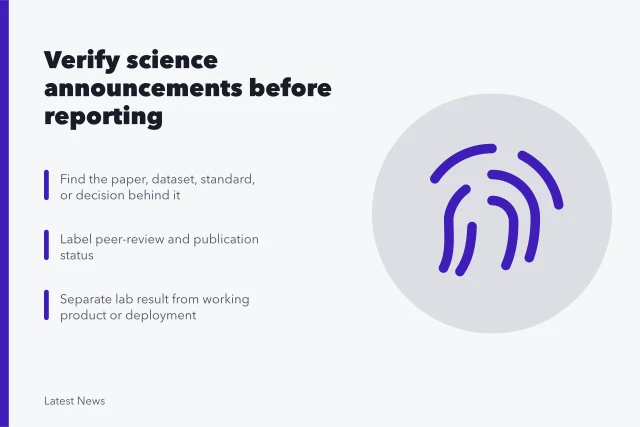
- Find the cited paper or repository record and confirm which version you are reading.
- Set the release headline beside the paper's own conclusion and note the gap.
- Read figures and tables first, then methods, then limitations.
- Treat a funding acknowledgment as a credit line, not an agency endorsement.
- Ask one outside expert one narrow question about method, not about significance.
A release can carry four different things at once: a new result, background the institution has used for years, applications nobody has tested, and quotes about future impact. Readers meet them as one claim. This workflow separates them, and it applies the science announcement reporting guide to a single document type.
Photo and credit
The photograph shows a flight console in 1969. It documents no current mission and no announcement.
Trace who wrote the release
Release record checklist
- Issuing institution
- Release date
- Media contact
- Embargo
- Cited paper
- Journal and DOI
- Dataset and software version
Then ask who wrote it. A researcher's own employer, a funder, a journal, a partner company and a company with a stake in the result all produce releases, and each has a different reason to lead with a different sentence. The issuer-first habit is the same one behind how to read a public health notice.
Establish publication status
Open the paper or repository record and name what it is:
What is the paper?
Preprint?
not peer reviewed
check accepted manuscript
A preprint has not been peer reviewed, and the release will often not say so.
Read backward from the claim
Start with the figures and tables that carry the headline claim, then read methods, results, limitations and abstract in that order. Note the sample, the comparison group, the primary outcome, any excluded data, and how uncertainty is reported.
Read backward from claim
- Start with figures and tables
- Read methods
- Read results
- Read limitations
- Read abstract
- Write one narrow sentence
Write the result as one sentence with no application language in it. If that sentence is much narrower than the release, the story follows the evidence. Sometimes the narrow sentence fails the story selection checklist and the assignment changes.
Audit support and interests
List the funders, the author affiliations, any patents, and any company roles. Also list who owns the data and the declared conflicts.
A funding acknowledgment is a credit line. It is not a finding that the funder approved the conclusions.
NSF requires grantees to acknowledge its support, and its brand standards policy keeps that acknowledgment separate from endorsement.
Many public materials carry the same split in plain words: the findings and recommendations are the authors' and do not necessarily reflect the agency's views.
Test the application leap
Ask what still stands between the reported result and a usable product. The usual gates include several stages:
- replication
- field testing
- safety review
- standardization
- manufacturing
- cost analysis
- integration
- approval
- user training
Engineering programs sometimes publish that distance as a number. NASA's explanation of technology readiness levels sets out a nine-step scale running from basic research to a system flight proven in a successful mission. When a release says a technology works, find where the project places itself on its own scale and which demonstrations are still owed.
Do not turn "could" into "will." Name who proposed the application and say whether anyone tested it.
Get one narrow outside read
Send the expert the paper, not the release. Ask about one or two specifics: is the comparator fair, is the measurement valid, is the uncertainty handled, does the application follow from the result. Disclose any relevant tie the reviewer has.
A quick quote does not replace reading the work, and any claim about the paper that starts circulating still goes through the breaking news verification checklist before it enters coverage.
Write an evidence-first opening
The opening states who did what, under which conditions, with what result, and at what publication stage. Broad future claims go lower, with attribution attached.
Common questions
Can an embargoed release be reported without the paper?
The release can support a note that an announcement was made. A findings story needs the underlying record, or a clear line saying it was not available when you published.
Does a grant mean the agency endorses the finding?
No. Support and endorsement are separate claims, and the acknowledgment language on the release usually says so.
Must every story include an outside expert?
Not always. Independent review earns its cost when a claim is surprising, consequential, or promoted by a company that stands to gain.
What if the release and the paper disagree?
Follow the paper for the research claim, ask the institution to explain the difference on the record, and report the discrepancy rather than smoothing it over.