Guides
How Bank of Canada Rate Hikes Affect Variable Mortgages: CAD Examples
Bank of Canada rate variable mortgage math, run under one hard limit: a single CAD 400,000 buyer with no rate forecast, no extra cash, and a strict 25 year payoff.
What to take away
- A variable-rate mortgage in Canada is priced off the lender's prime rate, and prime moves when the Bank of Canada changes its overnight rate target.
- On a CAD 400,000 variable mortgage at prime minus 0.60, a 0.25 percentage point cut saves roughly CAD 55 a month at the start; a 0.25 point hike costs about the same.
- The limit in this piece is one borrower, one CAD 400,000 mortgage, no rate forecast and no spare cash to prepay.
- Under that limit, switching to fixed is ruled out, and shopping lenders for a lower spread is the only lever that still works.
- The workaround stops paying once the spread saving falls below about CAD 15 a month.
What the constraint removes
Assume one borrower with a CAD 400,000 variable-rate mortgage amortised over 25 years, a closed term, and no lump-sum prepayment room. No rate forecast is allowed, because nobody has one that holds. No second property, no co-signer, no refinance.
That removes most of the standard advice. You cannot shorten the amortisation. You cannot blend and extend into a better structure. You cannot wait out a cycle on a fixed rate you locked earlier, because the mortgage is already variable.
It also removes the option of doing nothing at all. A variable rate resets with prime whether you watch it or not.
What still works
Payment changes flow through prime. When the Bank of Canada moves its target, Canadian lenders typically adjust prime within days, and a variable mortgage payment or its interest share follows. The Wikipedia entry on variable-rate mortgages sets out the mechanics of that pass-through.
Three levers survive the constraint.
- Call the lender and ask for the current spread, then ask what new customers are being offered on the same product.
- Compare that spread against at least two other lenders, using the same amortisation and term.
- Ask whether the payment is fixed or adjusts with prime, because the two behave differently when rates move.
The spread is the part you can actually change. Prime is not.
Example: one quarter point on CAD 400,000
Take a variable mortgage at prime minus 0.60. If prime is 4.95 per cent, the contract rate is 4.35 per cent. The figures below are illustrative, calculated on a standard amortisation schedule, not quoted from a lender.
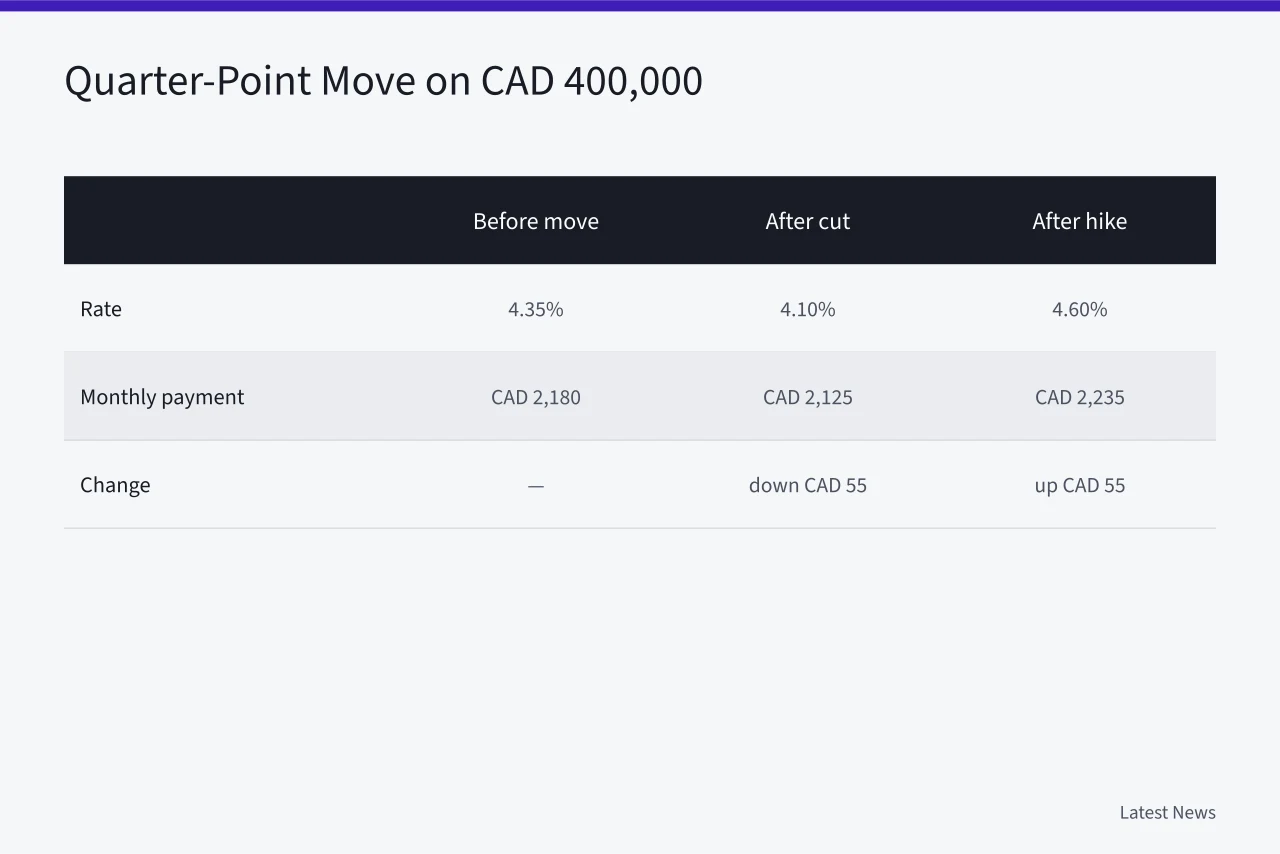
| Item | Rate | Monthly payment | Change |
|---|---|---|---|
| Before a 0.25 point cut | 4.35% | about CAD 2,180 | |
| After a 0.25 point cut | 4.10% | about CAD 2,125 | down CAD 55 |
| Before a 0.25 point hike | 4.35% | about CAD 2,180 | |
| After a 0.25 point hike | 4.60% | about CAD 2,235 | up CAD 55 |
The same arithmetic runs in reverse on the way up. A full percentage point of hikes adds roughly CAD 220 a month at this balance. That is the number to hold in your head, not the headline rate.
The Bank of Canada publishes its policy rate decisions and the reasoning behind them, and the Bank of Canada overview explains how the overnight rate target feeds into prime.
Compromises worth making
Switching lenders inside the same term usually means paying a penalty, so the honest move is to negotiate the spread at renewal. That costs a phone call and nothing else.
If the mortgage is up for renewal within a year, asking for a shorter term is reasonable. It keeps the variable exposure but buys a fresh negotiation sooner.
A small increase to the payment, if the lender allows it without penalty, cuts total interest. Under this constraint there is no spare cash, so treat that as a last resort.
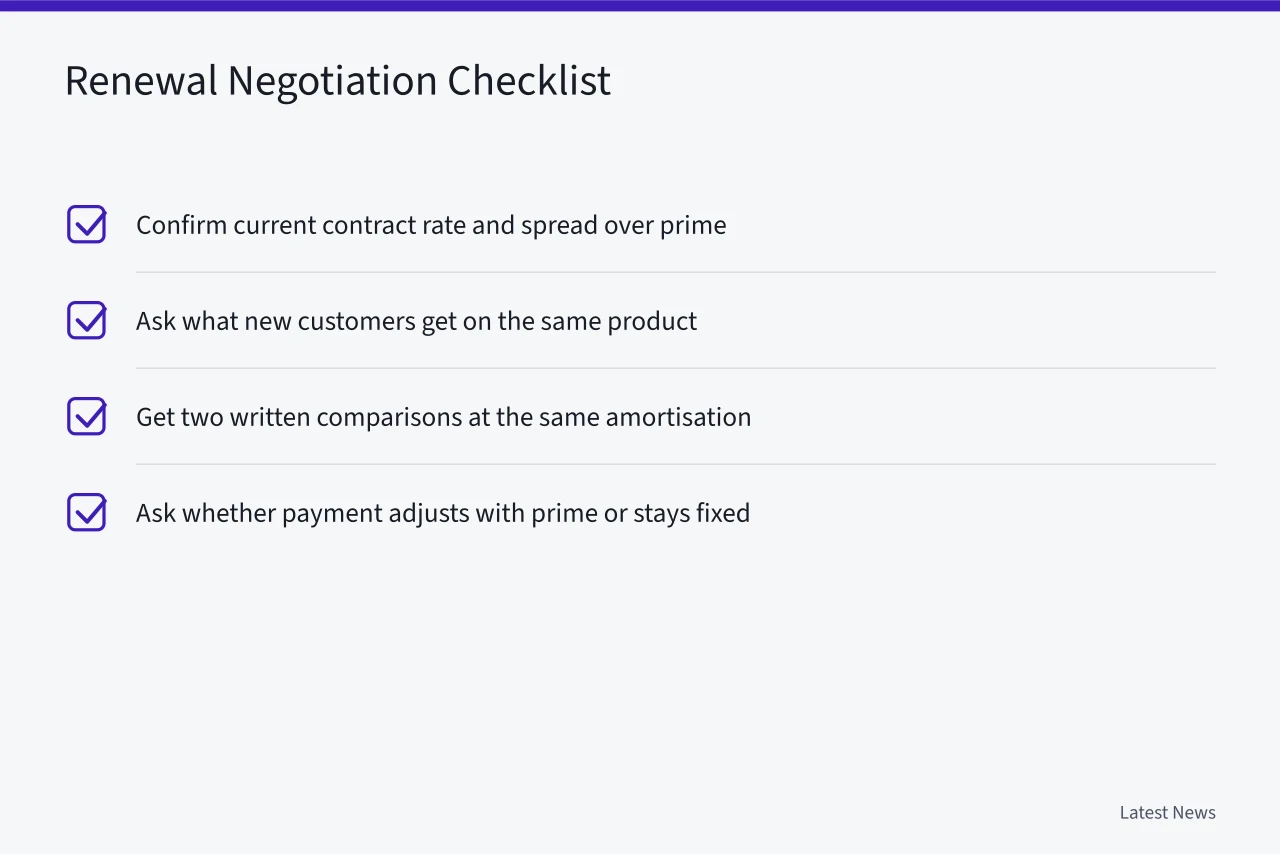
- Confirm current contract rate and spread over prime
- Ask what new customers get on the same product
- Get two written comparisons at the same amortisation
- Ask whether the payment adjusts with prime or stays fixed
Compromises that are not
Breaking the term to chase a lower spread rarely pays. Penalties on variable mortgages are often three months of interest, which can exceed a year of the saving.
Stretching the amortisation back to 30 years to lower the payment adds interest over the life of the loan and does not reduce the rate.
Taking a fixed rate purely because it feels safer is a rate forecast by another name. Under this constraint, no forecast is allowed, so that choice has to be argued on cash-flow certainty alone.
A lower spread is a saving you can measure today. A rate forecast is a guess you cannot.
When to stop and resource it properly
The workaround stops paying when the best spread you can negotiate saves less than about CAD 15 a month. At that point the phone calls and comparisons cost more in time than they return.
It also stops paying if a penalty quote comes back above roughly CAD 500, because the break-even stretches past the term.
When either threshold is hit, stop shopping and put the effort into a mortgage broker or a fee-only planner instead. That is the point where a professional opinion is worth paying for.
Common questions
Does prime rate Canada today move the day the Bank of Canada decides? Usually within days. Lenders adjust their posted prime after a target change, and variable contracts follow that posted rate.
Is the stress test relevant to an existing variable mortgage? No. The stress test applies when you qualify for a new mortgage or switch lenders, not to payments on a mortgage you already hold.
What is the single biggest lever under this constraint? The spread over prime. Prime is set by policy; the discount is set by the lender and is negotiable at renewal.