Guides
PFAS Drinking Water Limits by State: US EPA Standards Compared
PFAS drinking water limits by state vary from the EPA standard. This comparison covers Michigan, New Jersey, and New York MCLs and testing deadlines.
What to take away
- The federal EPA Maximum Contaminant Levels set a national floor: 4 ppt for PFOA and PFOS, 10 ppt for PFNA, PFHxS, and GenX, plus a hazard index of 1 for four PFAS.
- Some states have lower limits for particular PFAS, such as Michigan's 6 ppt for PFNA, while other state limits are less protective than the federal number.
- A public water system must comply with the stricter of the federal MCL and any state MCL for each PFAS compound.
- No current state or federal rule covers every PFAS chemical, so utilities must explain results for unregulated PFAS separately.
The US Environmental Protection Agency published the first national drinking water limits for six PFAS in April 2024. The rule applies to most community water systems and sets numeric Maximum Contaminant Levels that states must enforce at least as strongly as the federal standard.
The federal PFAS standard
EPA set individual MCLs of 4.0 parts per trillion for PFOA and PFOS and 10.0 parts per trillion for PFNA, PFHxS, and HFPO-DA, a GenX chemical. It also set a hazard index MCL of 1.0 for a mixture of PFHxS, PFNA, HFPO-DA, and PFBS. These numbers appear in the EPA's PFAS drinking water regulations.
That national standard is a floor, not a ceiling. States may adopt a lower numeric level for any covered PFAS. The EPA's state PFAS summary shows where state rules differ, and many states began setting MCLs before the federal rule.
State limits compared
Michigan, New Jersey, and New York each have individual PFAS MCLs that predate the federal rule. The table below compares selected state MCLs with the EPA levels. Values are in parts per trillion.
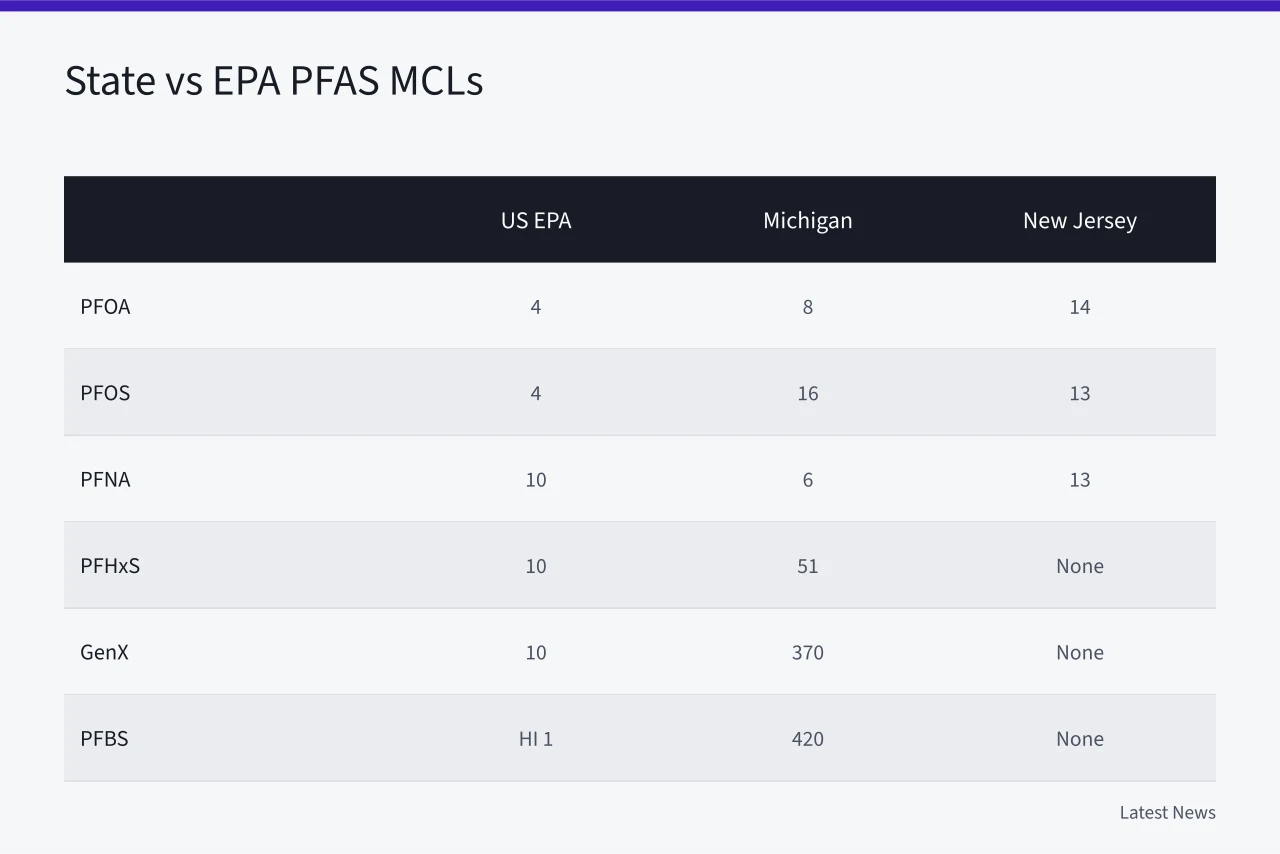
| Regulator | PFOA MCL | PFOS MCL | PFNA MCL | Other covered PFAS |
|---|---|---|---|---|
| US EPA | 4 | 4 | 10 | PFHxS 10, HFPO-DA 10, HI 1 |
| Michigan | 8 | 16 | 6 | PFHxS 51, GenX 370, PFBS 420 |
| New Jersey | 14 | 13 | 13 | None individual beyond PFNA |
| New York | 10 | 10 | No individual MCL | None |
State limits that are less strict than the federal MCL do not disappear. A water system must meet the more protective number for each PFAS compound.
State health departments often issue PFAS advisories alongside MCLs, just as local water advisories alert residents to heat and supply problems.
Michigan's PFNA limit of 6 ppt is stricter than EPA's 10 ppt. Michigan's PFOA and PFOS numbers are less strict than the federal 4 ppt, but the state still requires monitoring and reporting when those values are exceeded. New Jersey's three individual MCLs offer fixed numbers for PFOA, PFOS, and PFNA, though all are above some federal levels. New York's 10 ppt for PFOA and PFOS matches many state rules but is not stricter than the federal 4 ppt.
Testing and compliance timetable
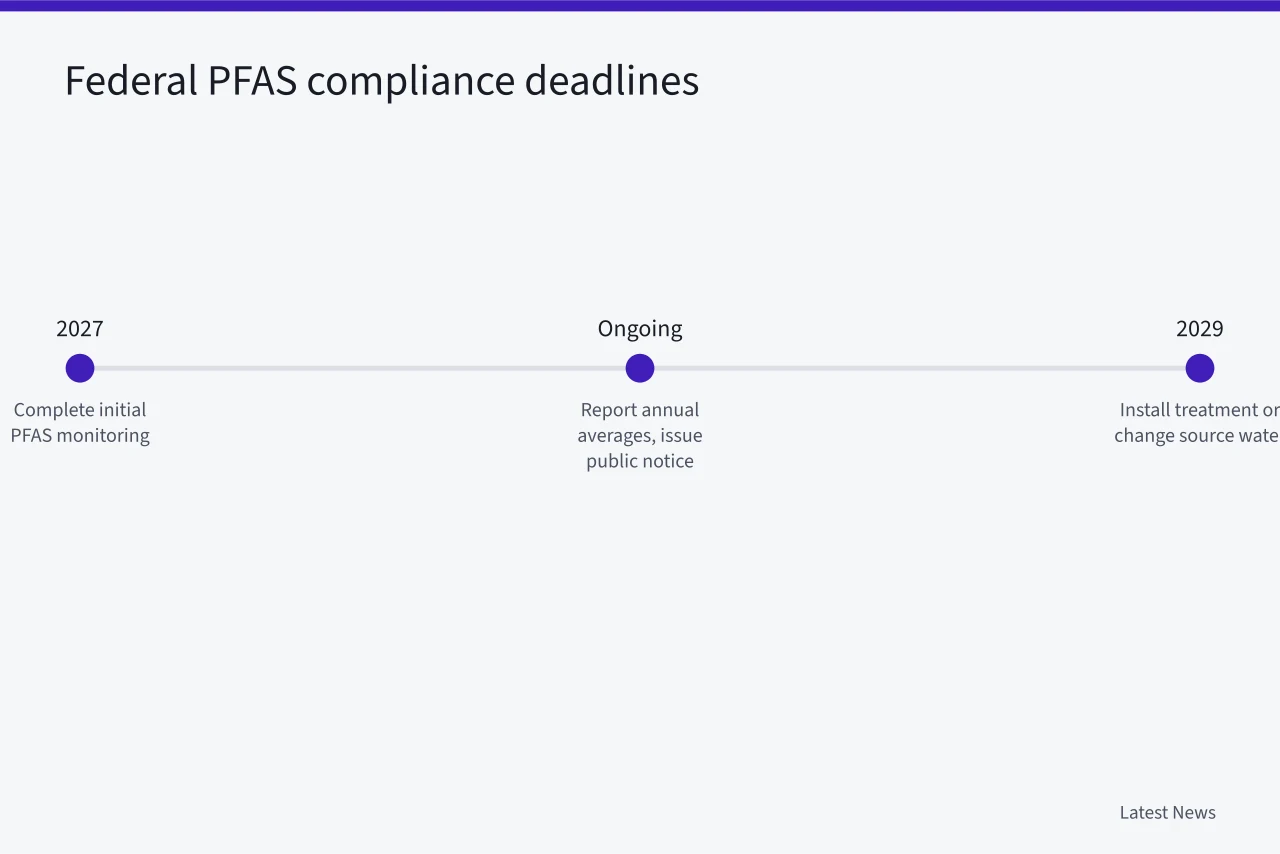
The federal rule sets deadlines that can work alongside state requirements. Key steps for a community water system are:
Public notice in PFAS cases is similar to the customer alerts explained in Chicago water main breaks, though PFAS exceedances are not boil-water events.
Where each approach wins
The federal baseline is right for water systems that need one clear national floor and for states without their own MCLs. Michigan is the better fit for utilities with PFNA contamination, because its 6 ppt PFNA MCL is lower than the federal 10 ppt. New Jersey's rule is useful for systems that already report three individual PFAS values and want continuity with earlier state sampling. New York's 10 ppt for PFOA and PFOS remains the right frame for systems that built their sampling plans around that number before 2024.
This overlap shows why state and federal rules can be explained together, much like federal vs state emergency alerts.
What no standard covers yet
The shared limit is chemical coverage. The federal rule addresses six PFAS individually and a four-chemical hazard index. Michigan and New Jersey cover several individual PFAS, but none of the standards sets an MCL for every PFAS compound detected in water. A utility can meet all MCLs and still have measurable amounts of PFAS chemicals with no federal or state limit.
Rainfall and flooding can move PFAS into source water, which adds another layer to flood risk reporting.
Common questions
Does my state have stricter PFAS limits than the EPA? Check your state's MCL for PFOA, PFOS, and PFNA. A stricter limit is a lower part-per-trillion number. Several states have at least one PFAS limit lower than EPA's corresponding level, but not always for every compound.
Do utilities have to test for PFAS? Yes, public water systems must test under the federal rule. Initial monitoring deadlines begin in 2027 for many systems, and some states require earlier testing.
What happens if a system exceeds an MCL? The system must notify customers and reduce the PFAS level by treatment, blending, or a new source by 2029. States can impose additional deadlines.
Are all PFAS covered? No. The federal rule covers six PFAS individually and a hazard index for four more. Thousands of PFAS remain unregulated.