Maintenance
Part of Weather, disasters, and public safety: a reporting guide
Public safety alert reporting checklist: what to confirm before publishing
Public safety alert checklist for verifying sender, event, area, timing, hazard source, expected impact, protective action, accessibility, updates, and cancellation.
What to take away
- Confirm the sender and full official message.
- State the event, location, timing, and protective action together.
- Preserve evidence tags and expected impacts.
- Make instructions understandable without a map or color key.
- Assign ownership for updates and cancellation.
Use this checklist for wireless alerts, weather warnings, evacuation messages, shelter instructions, and other immediate public-safety notices. A blank affecting action, geography, or time blocks publication until it is resolved or clearly labeled unknown. It turns the weather and public safety reporting guide into checkable fields.
Sender and authority
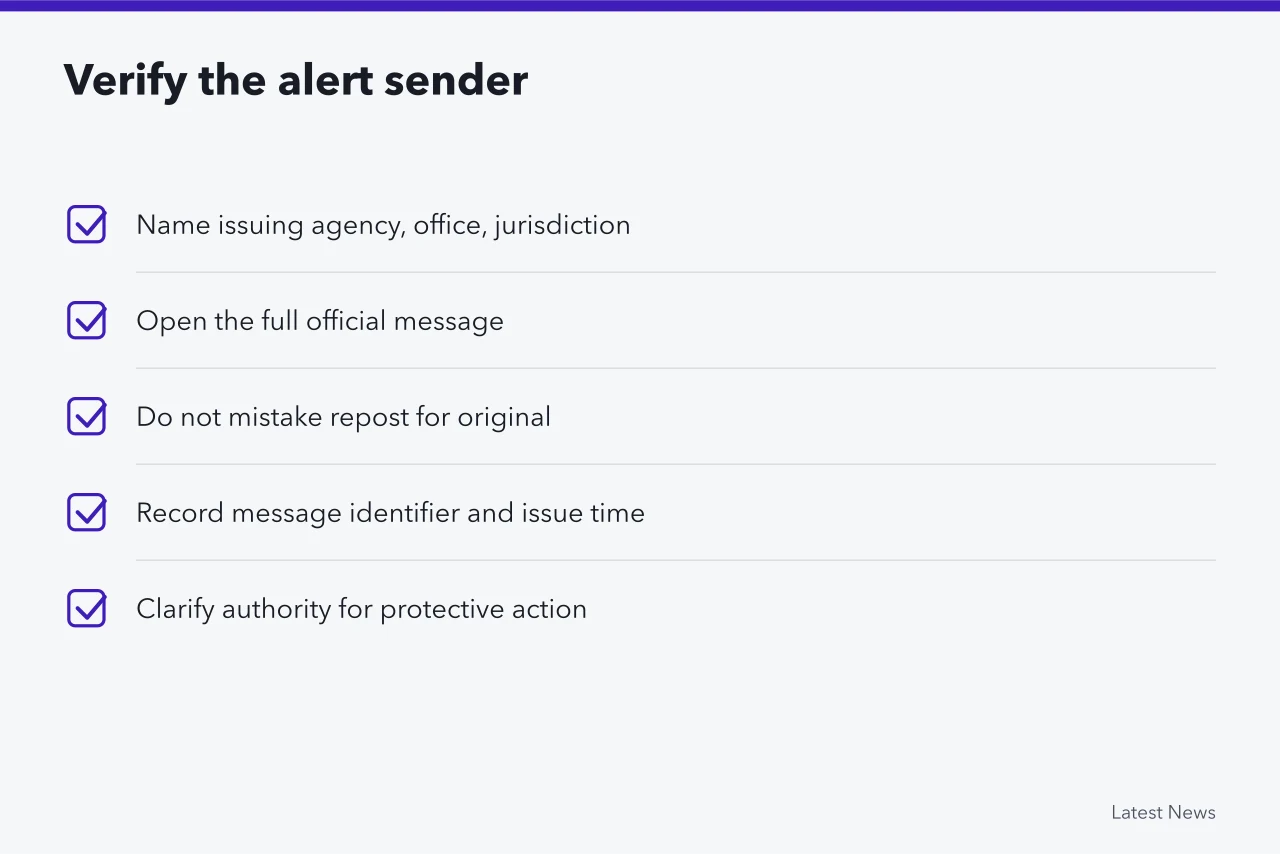
- Issuing agency, office, and jurisdiction are named.
- The full official message is open.
- A repost is not mistaken for the original issuer.
- The message identifier and issue time are recorded.
- The authority responsible for protective action is clear.
FEMA calls IPAWS a communications system for authorized federal, state, local, tribal, and territorial officials. Its Wireless Emergency Alert best-practices sheet says effective messages name the trusted sender, event, location, and protective action. They also name duration or expiration and a route to more information.
It says the alerting authority, not FEMA, decides message content and whether to update or cancel it. The step-by-step read of one product is how to read a weather alert.
Event and evidence
- The hazard or incident is named in plain language.
- Observed, radar indicated, forecast, reported, and suspected are not mixed.
- Measurements retain units, place, and time.
- Preliminary values are labeled.
- Rumors and unverified public posts are excluded from confirmed facts.
Geography and timing
- Polygon, zone, county, route, river reach, or facility is interpreted correctly.
- Partly covered places are not described as fully covered.
- Start, arrival, expiration, and update times include a time zone.
- Road and shelter information comes from the responsible local authority.
- A map has text alternatives for its main instruction.
Impact and action
- Expected impact is separated from the hazard itself.
- The official action is near the top.
- Conditional instructions retain their conditions.
- Evacuation route or shelter details have been checked.
- The article does not invent an all-clear.
The National Weather Service says impact-based warnings organize information into hazard, source, and impact fields and can include event tags about risk, expected damage, and magnitude. The NWS impact-based warning overview supports reading those fields directly and noting that certain high-impact tags can trigger wireless alerts. Product-notice coverage runs the parallel health alert reporting checklist.
Language and accessibility
- The headline uses the official action and affected place.
- Technical codes are translated without being discarded.
- Color is not the only way to convey status.
- Phone numbers and destinations are readable and checked.
- Translation status and language availability are stated when relevant.
For a worked example of instruction-first coverage under a recall, see the fictional food recall outbreak case.
Update controls
- The source was reloaded immediately before publication.
- A named editor owns the next check.
- The next scheduled bulletin or expiration is on the desk calendar.
- Superseded instructions will be removed from headline, summary, captions, and social text.
- Cancellation or all-clear will be attributed to the proper authority.
Common questions
Does FEMA write every wireless alert?
No. Authorized alerting authorities are responsible for message content and decisions within their jurisdictions.
Is an alert map enough to explain the area?
No. Provide a text description and check whether the boundary covers all or part of named places.
Can "radar indicated" be shortened to "confirmed"?
No. Keep the evidence label supplied by the warning.
What happens when an alert expires?
Check for a replacement, cancellation, continuing secondary hazard, or official all-clear before changing public instructions.