Rules
Special Counsel vs Attorney General: How US Federal Investigations Differ
Special counsel vs attorney general: how US federal investigations differ in appointment, scope, removal and reporting, plus a criteria table and shared limits.
What to take away
- The Attorney General runs the Department of Justice and can direct any federal investigation. A special counsel is a DOJ lawyer appointed to handle one matter, with day to day independence but no separate agency.
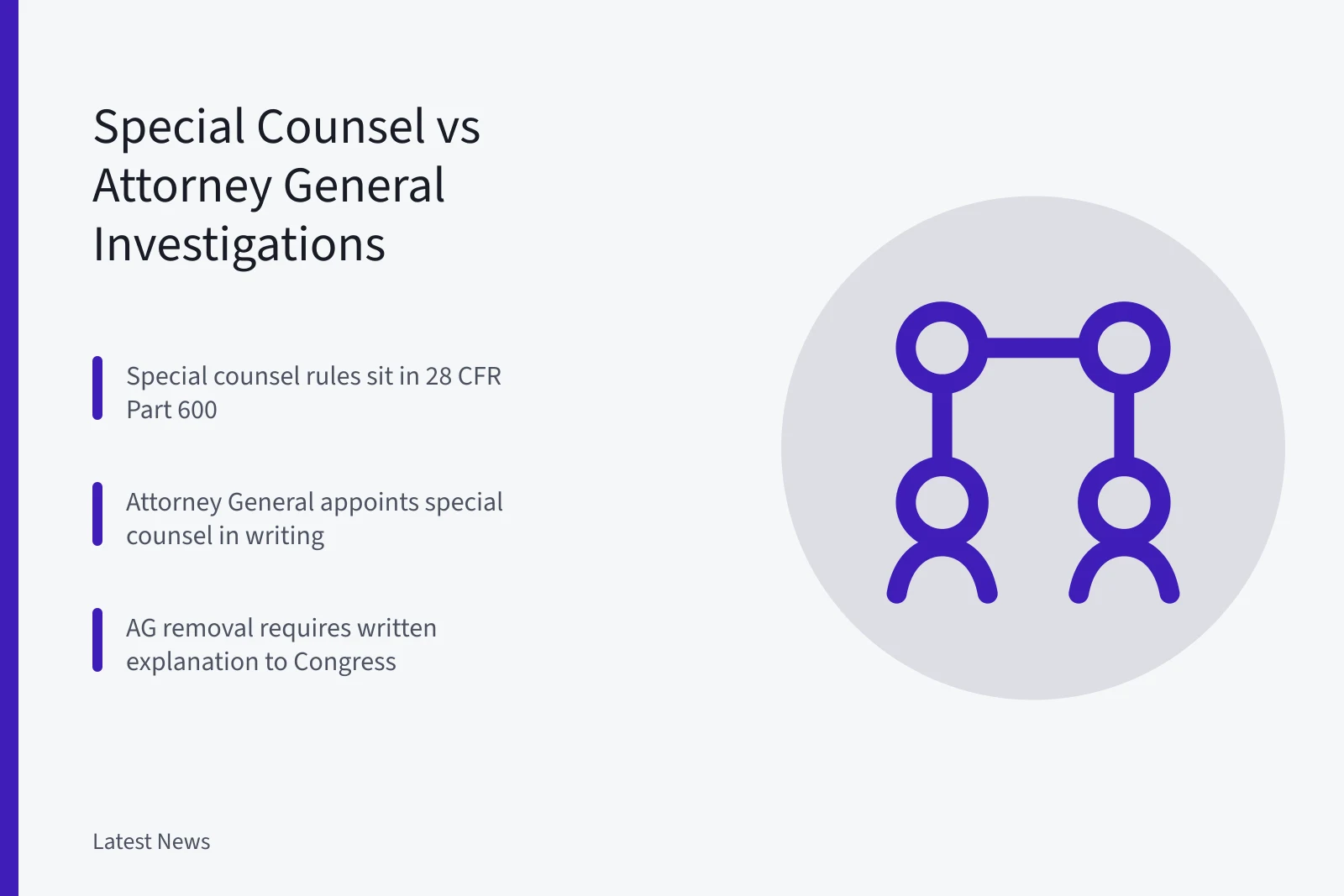
- The special counsel rules sit in 28 CFR Part 600. They require a written appointment order, a defined jurisdiction, and notice to Congress when the counsel is appointed or removed.
- The Attorney General can remove a special counsel, but must give Congress a written explanation. The old independent counsel statute, which expired in 1999, used a three judge panel and a narrower removal standard.
- Neither role creates a court supervised prosecutor. A grand jury, a judge and the normal rules of evidence constrain both.
- The practical difference for a reader is who sets the scope, who can widen it, and who explains a decision to the public.
What is being compared
Two ways of running a politically sensitive federal investigation. In one, the Attorney General or a confirmed senior official keeps the case. In the other, the Attorney General hands the matter to a special counsel and steps back from day to day control.
The Attorney General is a Senate confirmed officer who heads the Department of Justice and advises the President on legal matters. That office is described on the department's own page for the Attorney General's duties and authority over federal investigations.
A special counsel is a lawyer, usually a career prosecutor or a former judge, appointed under department regulations. The role is not a permanent office and carries no fixed term. The Justice Department's Office of Legal Counsel has published opinions on how those regulations work, collected at the DOJ Office of Legal Counsel.
The older independent counsel was different. That system came from a 1978 statute and ended when the law expired in 1999. It let a special division of the federal appeals court pick the prosecutor, which the current rules do not.
The criteria that matter
The comparison turns on five questions a reader can ask about any investigation.
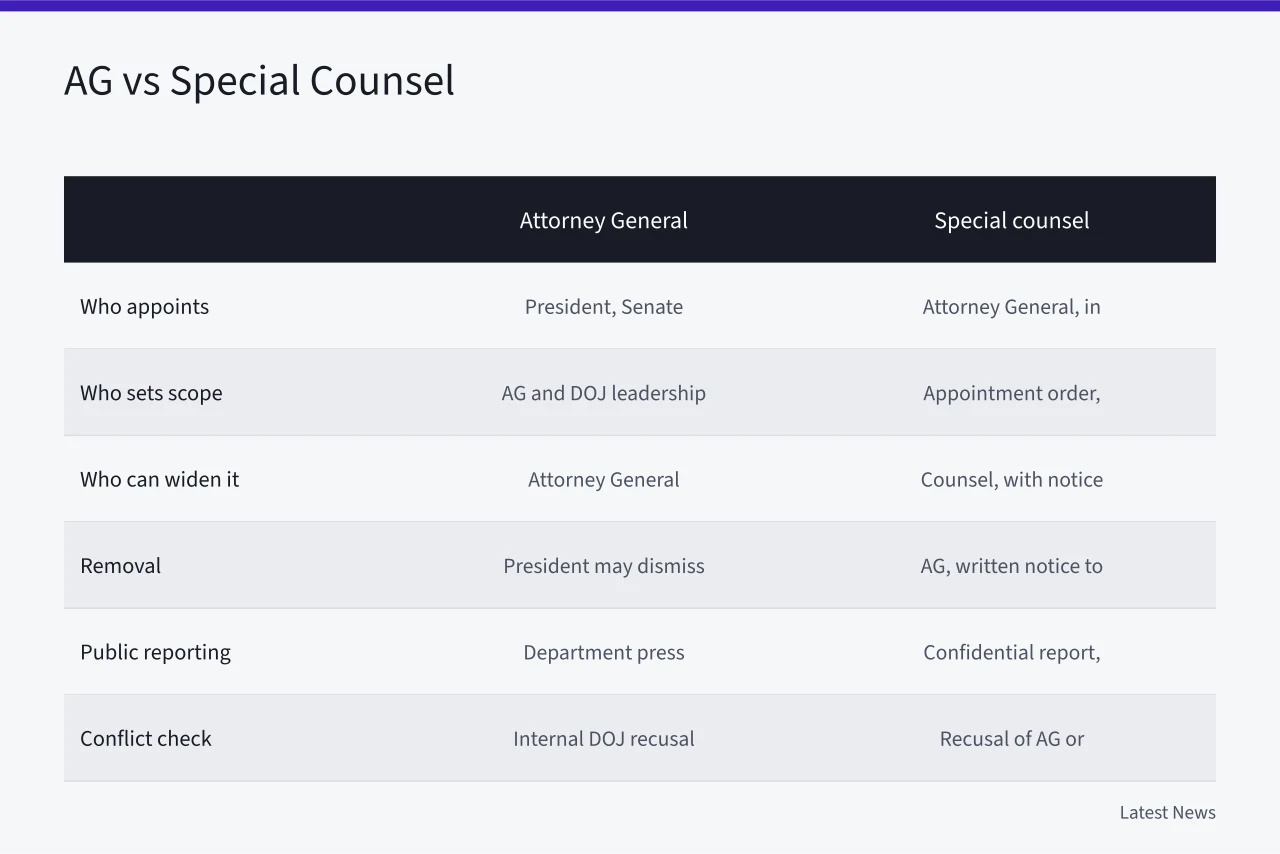
| Criterion | Attorney General route | Special counsel route |
|---|---|---|
| Who appoints | President, with Senate confirmation | Attorney General, in writing |
| Who sets scope | Attorney General and DOJ leadership | Appointment order, then the counsel |
| Who can widen it | Attorney General | Counsel, with notice to the Attorney General |
| Removal | President may dismiss the AG | Attorney General, with written notice to Congress |
| Public reporting | Department press statements and policy | Confidential report to the Attorney General, later released in part |
| Conflict check | Internal DOJ recusal practice | Recusal of the Attorney General or others |
Option by option
The Attorney General route is the default. Most federal investigations, including many with political overtones, stay inside the department and are supervised by a United States Attorney or a division chief. The Attorney General sets priorities, approves major charges and answers to the President.
That structure is fast and accountable to an official the Senate confirmed. It also creates an obvious problem when the investigation touches the President, the White House or the Attorney General's own conduct.
The special counsel route answers that problem. The Attorney General writes an order naming the matter, the legal authority and the counsel's jurisdiction. The counsel then runs the investigation, hires staff, and decides whether to charge, subject to department policy.
Independence here is administrative, not constitutional. The counsel is still a department employee, still bound by the Justice Department manual, and still subject to the Attorney General's removal power. The written notice requirement to Congress is the main check.
Example: how a special counsel ends
A special counsel investigation typically closes in one of three ways. The counsel may bring charges and prosecute them. The counsel may decline charges and explain why. Or the counsel may write a confidential report to the Attorney General, who decides what to release.
That last path is where public confusion usually starts. The report is not a court verdict. It is a prosecutorial judgment, and the Attorney General can release it in full, in part, or not at all. Readers who want the underlying rules can start with the US Code provisions on Attorney General and special counsel appointment.
Where each one wins
The Attorney General route wins when speed, clear command and ordinary accountability matter. A single chain of command lets the department move quickly on fraud, public corruption or national security matters that cross several offices.
The special counsel route wins when the appearance of conflict is the central fact. If the President, the Attorney General or senior White House staff are potential subjects, an outside prosecutor protects the department's credibility as much as the investigation itself.
For a reader tracking a case, the signals are different. Under the Attorney General, watch department statements and charging decisions. Under a special counsel, watch the appointment order, any expansion of jurisdiction, and the removal notice to Congress.
What none of them solve
Neither route removes politics from a federal investigation. The Attorney General serves at the President's pleasure. A special counsel can be removed by an Attorney General who also serves at the President's pleasure. The notice requirement creates a record, not a barrier.
Neither route gives the public a running account. Federal investigations are secret by design, and grand jury material stays sealed. A reader waiting for a definitive answer will usually wait past the point where the news cycle has moved on.
Both routes also depend on the same courts. A judge decides motions to dismiss, subpoena fights and sentencing. No appointment order changes the burden of proof, the rules of evidence or the defendant's rights.
Common questions
Can the President fire a special counsel? Not directly. The removal power sits with the Attorney General, who must notify Congress in writing with an explanation. In practice a President can direct that removal, which is why the notice requirement exists.
Is a special counsel the same as an independent counsel? No. The independent counsel came from a separate statute that expired in 1999 and was appointed by a court panel. Today's special counsel is appointed under Justice Department regulations and remains a department employee.
Does a special counsel report carry legal weight? It is a prosecutorial document, not a ruling. Courts, grand juries and trials decide guilt. The report explains charging decisions and can be released in part at the Attorney General's discretion.
Who can expand a special counsel's jurisdiction? The counsel can investigate matters within the order and related matters, with notice to the Attorney General. A significant expansion is normally documented, which is often the first public sign that a case has grown.