Rules
What Is a Continuing Resolution? A US Government Shutdown Explainer
A continuing resolution is stopgap spending that keeps agencies open past the fiscal deadline. Here is what it covers, what it costs, and when it lapses.
What to take away
- A continuing resolution, or CR, is temporary appropriations law. It funds agencies at or near the prior year's rate when the twelve annual appropriations bills are not enacted by October 1.
- The federal fiscal year runs October 1 through September 30. The government shutdown deadline is that October 1 date, and a CR moves it.
- A CR is not a budget. It freezes program levels, blocks new starts, and usually holds spending near the prior year rather than the President's request.
- The cost of a shutdown is not a single number. Estimates cluster in the low billions per week, and they are illustrative ranges, not audited totals.
- What would have to be true for a CR to matter: it must expire before the full bills pass, and the two chambers must still disagree on topline totals.
The appropriations vs continuing resolution distinction
Appropriations bills are the regular work. Congress writes twelve of them each year, one per spending area, and each sets a specific dollar amount for named programs. A continuing resolution is different in kind. It does not set new program levels. It extends the prior year's levels for a stated period, often a few weeks or a few months.
The practical effect is a freeze. Agencies operate at the rate in force at the start of the fiscal year. New programs cannot begin, and hiring for many positions stalls. The Congressional Research Service tracks how these stopgaps have been used since the 1970s.
The White House submits a budget request each February. Congress is supposed to act on it before the fiscal year ends. When it does not, a CR is the tool that prevents a lapse in appropriations. A lapse is what produces a shutdown.
What the range covers
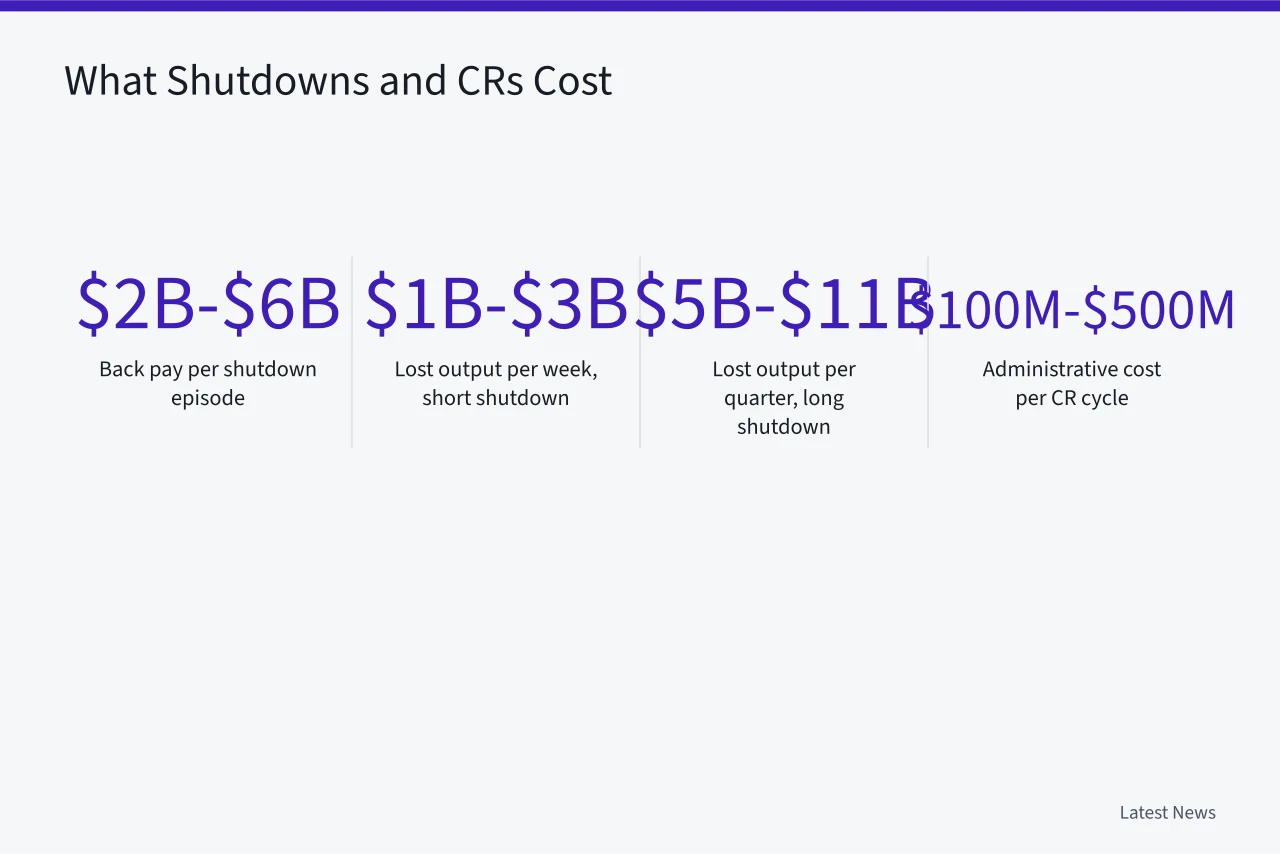
The figures below are illustrative ranges drawn from published analyses, not a single audited cost. They show what the money buys and what it fails to buy.
| Cost item | Illustrative range | One-off or recurring |
|---|---|---|
| Back pay for furloughed federal employees | $2 billion to $6 billion per shutdown episode | One-off |
| Lost economic output, short shutdown | $1 billion to $3 billion per week | Recurring while it lasts |
| Lost economic output, long shutdown | $5 billion to $11 billion per quarter | Recurring while it lasts |
| Administrative cost of CR extensions | $100 million to $500 million per cycle | Recurring |
| Delayed federal contracts and grants | $1 billion to $10 billion in deferred spending | One-off, timing shift |
The Government Accountability Office has documented how shutdowns disrupt federal operations, including inspections and permitting. Those delays carry costs that never appear on a budget line.
Line by line: what a CR actually funds
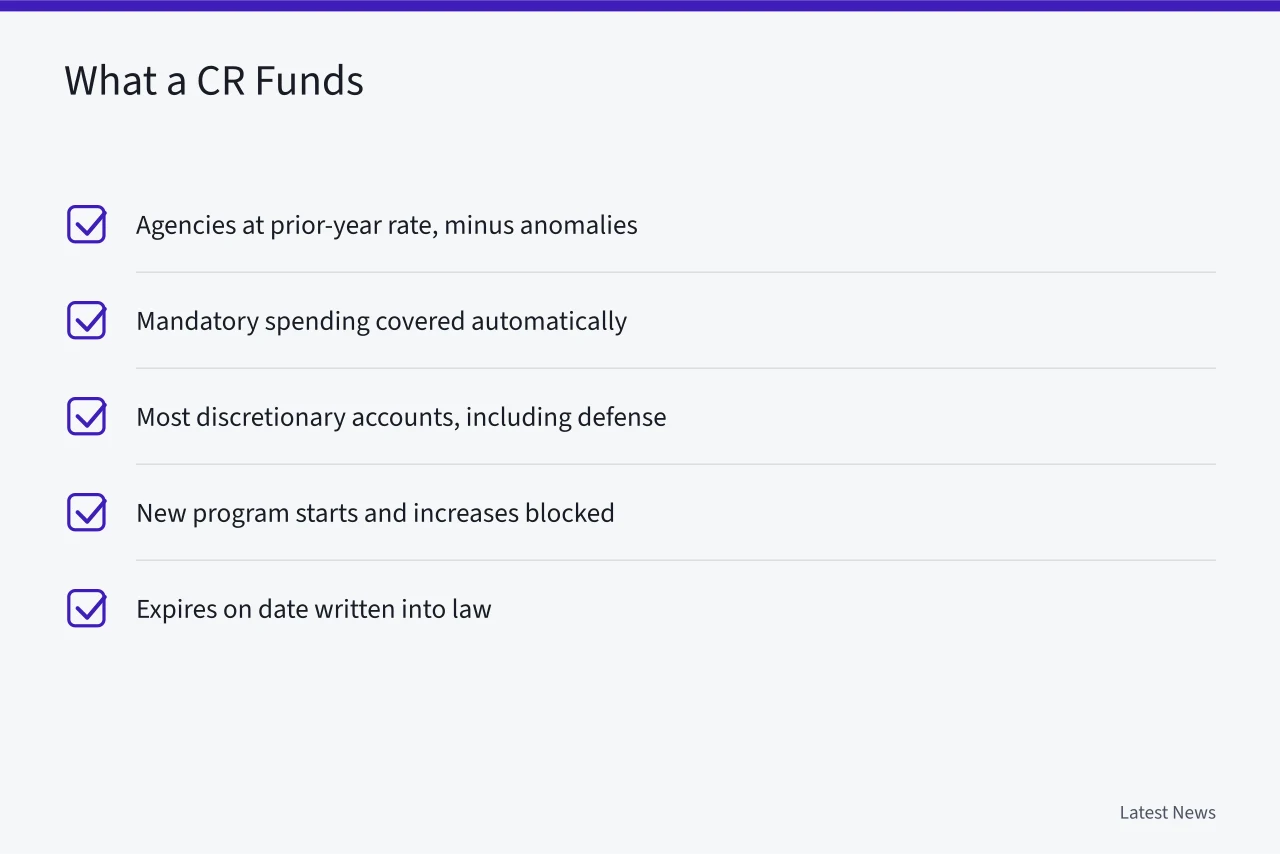
- It funds agencies at the rate in effect at the start of the fiscal year, minus any anomalies Congress adds.
- It covers mandatory spending automatically. Social Security and Medicare do not depend on annual appropriations.
- It covers most discretionary accounts, including defense operations and maintenance.
- It blocks new program starts and most increases above the prior rate.
- It expires on a date written into the law, which resets the shutdown deadline.
An anomaly is a specific exception. Congress can add one to let an agency spend above the frozen rate for a named purpose, such as disaster response or a census. Without an anomaly, the agency stays at the old level.
Fixed against variable
Some spending is fixed by formula and does not move with a CR. Interest on the debt is the largest example. Mandatory programs follow their authorizing statutes.
Other spending is variable and does move. Discretionary accounts shrink in real terms when a CR holds them flat and inflation runs above zero. A flat dollar figure buys less each month the CR lasts. That erosion is the quiet cost of every stopgap.
A continuing resolution does not fund the government at the level Congress wants. It funds it at the level Congress last agreed on.
Readers tracking the wider budget picture can see how the BLS CPI and BEA GDP releases frame the inflation side of that erosion. The same data series inform the topline arguments on Capitol Hill.
What the tools do not include
A CR does not resolve the underlying disagreement. It postpones it. The topline totals for defense and nondefense accounts remain unsettled, and the twelve bills remain unwritten.
It also does not cover every federal function. Agencies with multiyear or no-year appropriations keep spending under their existing authority. Agencies with annual appropriations stop when the money lapses.
Essential functions continue during a lapse. Air traffic control, border security, and federal law enforcement keep operating. National parks and many administrative offices close. The history of US government shutdowns shows how the boundary between essential and nonessential has shifted over time.
Where budgets leak
The leaks are timing and uncertainty. Agencies cannot sign multiyear contracts when funding expires in six weeks. Vendors price that risk into bids, and the government pays more.
Hiring is another leak. A freeze on new hires pushes work onto existing staff, and backlog grows. Inspections and permit reviews slow down, which shifts cost onto regulated firms.
A third leak is the CR cycle itself. Each extension requires staff work, votes, and legal review. That work is recurring, and it produces no new program or service. For how these deadlines reach readers in practice, see how BLS monthly jobs reports get built around the same fiscal calendar.
Example: a sixty-day CR
Suppose Congress passes a CR on September 28 that funds agencies through November 27. The shutdown deadline moves from October 1 to November 28. Agencies operate at prior-year rates for eight weeks.
If the twelve bills are still unfinished on November 27, Congress must pass another CR or let funding lapse. A lapse triggers a shutdown. The cost of that outcome is the range in the table above, and it is borne partly by employees who are later paid back and partly by output that is never recovered.
Common questions
Does a continuing resolution stop a shutdown? It prevents one only while it is in force. When the CR expires without a new law, the shutdown deadline returns and a lapse becomes possible again.
Is a CR the same as an omnibus? No. An omnibus packages several or all twelve appropriations bills into one law and sets new program levels. A CR extends prior levels for a set period.
Who decides how long a CR lasts? Congress sets the expiration date in the text of the law. The President signs it or vetoes it, and a veto returns the deadline question to the chambers.
Which agencies keep running during a lapse? Those performing excepted functions, such as air traffic control and border security, continue. Others furlough staff and suspend nonessential work, as federal emergency alert systems illustrate when public warnings must continue without new funding.