Guides
How Canada's Rate Cuts Reach US Mortgage and Utility Bills
Bank of Canada rate cuts reach US borrowers through currency, variable debt, and utility rate cases. Track the transmission channels and timing gaps.
What to take away
- The Bank of Canada rate decision impact on US borrowers runs through currency, credit, and regulated utility timing.
- A Bank of Canada rate cut changes the Canadian dollar, cross-border funding costs, and the direction of US rate expectations.
- US mortgage rates are set mainly by Treasury yields and Federal Reserve expectations, not by the Bank of Canada directly.
- Utility bills respond to state rate cases, fuel contracts, and commission schedules that often lag financial markets by months.
- The clearest household link runs through variable-rate debt, imported prices, and the trade and climate stories that reshape supply.
How a Bank of Canada Rate Cut Travels to US Borrowers
The Bank of Canada sets its policy interest rate to guide inflation and employment. That target anchors Canadian short-term borrowing and influences the Canadian dollar.
When Canada cuts, the loonie often weakens against the US dollar. A weaker loonie can raise the cost of US imports from Canada, including energy, lumber, auto parts, and food. That feeds into US producer prices and some consumer bills.
US mortgage rates do not copy the Bank of Canada. They track the 10-year Treasury yield, the Federal Reserve's policy path, and mortgage-backed securities spreads. Still, a Canadian cut can shift global rate expectations at the margin.
Variable-rate mortgages respond fastest to central bank moves. A US home equity line or adjustable-rate mortgage tied to SOFR or the prime rate can reprice after Fed decisions.
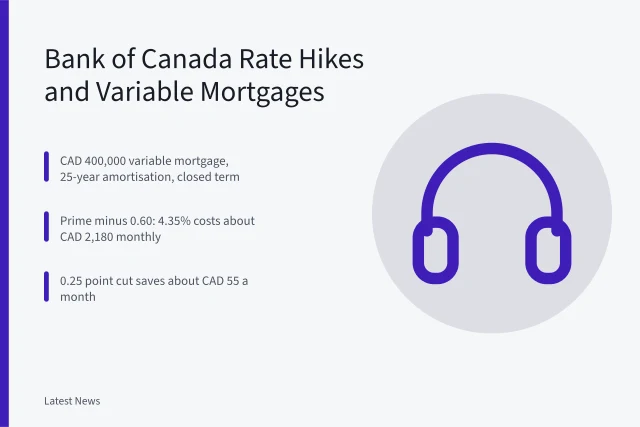
Variable-rate mortgages reprice when their benchmark changes, as this variable-rate mortgage overview explains. For a Canadian comparison, see the CAD 400,000 mortgage math that runs one buyer under a strict 25 year payoff.
| Transmission channel | What moves first | US household cost |
|---|---|---|
| Currency | USD/CAD exchange rate | Imported goods and energy |
| Rate expectations | Treasury yields and SOFR | Variable-rate debt |
| Trade flows | Orders and supply contracts | Autos, food, building materials |
| Utility fuel | Gas and power contracts | Electric and gas bills |
The table shows why a single rate decision reaches different bills at different speeds. Currency markets react in minutes. Utility commissions react in months.
Cross-border interest rate spillover is small for fixed US mortgages but larger for traded goods and variable debt.
Example: One Canadian Rate Cut, Three US Bills
Use this sequence to track the effects without a forecast.
- Check the Bank of Canada announcement date and the new overnight rate target.
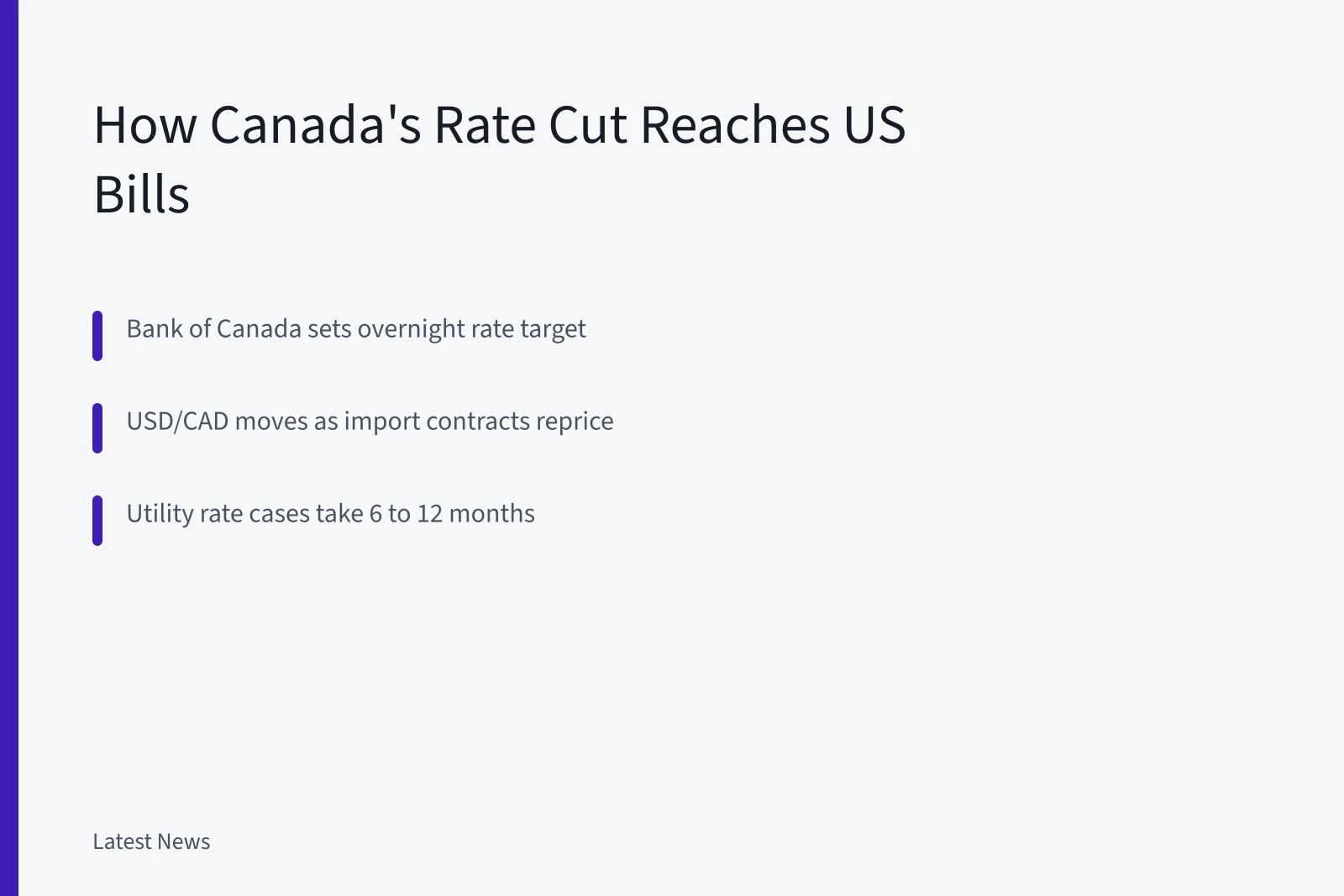
- Watch the USD/CAD exchange rate for two weeks, since import contracts reprice on different schedules.
- Compare your variable-rate debt index, such as SOFR or prime, with the Fed's next meeting.
- Find your state utility commission docket to see if a rate case is pending.
A rate cut can lower a Canadian lender's funding cost while your US utility bill stays flat. The timing gap is the story.
Why Utility Bills Move on a Different Clock
Utility bills follow a slower clock. A rate case is a state commission review of a utility's request. The test is whether the utility's return on equity lands in an allowed range.
The rate case process often takes 6 to 12 months, so US utility rate case timing follows state calendars, not central bank meetings. The state rate case review explains the allowed return test in detail.
Check your own exposure with this list:
- Locate your state public utility commission docket search.
- Note the utility's requested return on equity.
- Check the test year and rate effective date.
- Track fuel adjustment clauses separately from base rates.
Natural gas prices, storm recovery costs, and transmission projects can raise bills even when interest rates fall. A Canadian rate cut may lower some financing costs for utilities with cross-border parent companies. It rarely changes a commission's schedule.
A rate cut is a signal, not a bill. The bill arrives through currency, contracts, and commissions.
Cross-Border Trade and Climate Storylines That Reach Your Bills
Trade and climate policy set the physical costs behind many utility and household bills. Energy imports, auto parts, agricultural goods, and border rules all move through the same corridors. The cross-border trade and climate desk tracks these links for US readers, including the International Joint Commission and USMCA rules.
A Canadian rate cut can change investment in energy projects, electric vehicle supply chains, and cross-border power. Those changes can appear in rate cases years later. They can also change the price of imported equipment that utilities buy.
Climate rules can raise or lower utility costs. Transmission upgrades, storm hardening, and renewable procurement all enter rate cases. Trade rules can change the price of solar panels, transformers, and batteries. A rate cut can influence whether projects get built on schedule.
Canada rate cut US dollar effects show up in import prices first. They reach mortgage and utility bills later through contracts and rate cases.
For US borrowers, the practical path is to separate market signals from regulated prices. Market signals move quickly. Regulated prices move on a docket calendar.
Common questions
Does a Bank of Canada rate cut lower my US mortgage rate?
Not directly. It can influence global rate expectations and the US dollar, but your mortgage rate depends on Treasury yields, the Fed, and your lender's spread.
Why would a Canadian rate cut affect my electric bill?
It can change the Canadian dollar and the price of imported fuel, equipment, and power. Your bill also depends on state rate cases and fuel contracts.
How fast do variable-rate mortgages react?
Typically at the next scheduled reset or payment change. The exact timing depends on your loan terms and benchmark.
What should I track first?
Track the Bank of Canada announcement, the USD/CAD rate, your debt benchmark, and your state utility commission docket.