Guides
How Canada's Rate Cuts Reach US Mortgage and Utility Bills: A Reader's Guide
Canada's rate cuts reach US borrowers through bond yields, the dollar, and utility rate cases. A channel-by-channel guide to timing, odds, and limits.
What to take away
- Bank of Canada cuts reach US mortgage rates mainly through long-term bond yields and the exchange rate, not through any direct rule.
- US mortgage rates track the 10-year Treasury yield, so an Ottawa move matters only if global long yields follow it.
- Utility bills respond slowly because rate cases use bond yields to set allowed returns and revenue requirements.
- A wider Canada-US rate gap usually softens the loonie, which shifts import prices, inflation, and Fed expectations.
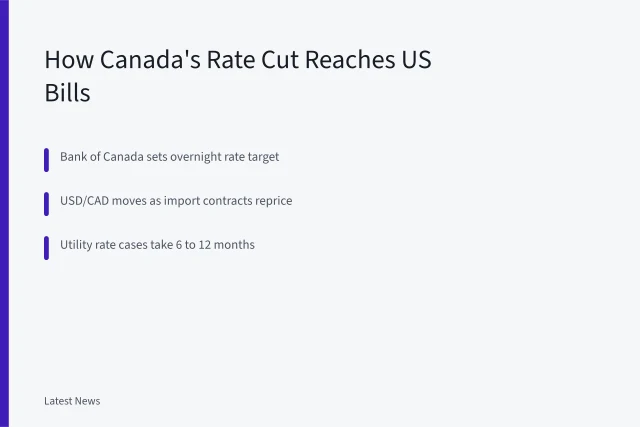
- Timing gaps run from days in bond markets to a year or more in a regulated utility proceeding.
The Bank of Canada Decision and the Long Bond Market
The Bank of Canada sets an overnight target rate for the Canadian dollar. That rate anchors short-term borrowing inside Canada. US mortgage rates, though, follow long-term benchmarks, above all the 10-year Treasury note.
So the real question is whether an Ottawa cut moves long yields. It often does, partly, because Canadian and US government bonds trade as substitutes. Global investors compare the two constantly. Bank of Canada policy shapes the front end of that curve.
A cut signals weaker Canadian growth. If traders read it as a North American slowdown, Treasury yields slip and mortgage rates follow. If they read it as purely domestic, the effect fades within days.
That condition is the whole point. Nothing forces US lenders to reprice because Ottawa moved.
Why the Dollar Is a Second Channel
Canada and the United States trade heavily, so the exchange rate carries policy across the border too. When Canada cuts faster than the Federal Reserve, the interest gap widens. Capital tends to favor dollar assets, and the Canadian dollar weakens.
A weaker loonie makes Canadian goods and services cheaper for US buyers. It also makes US exports pricier north of the border. Both effects nudge import prices and inflation, which the Fed watches.
Currency moves also tighten or loosen financial conditions. A stronger dollar can slow US manufacturing. That can pull long yields down, which helps mortgage shoppers.
Example: How a Cut Shows Up in a Variable-Rate Loan
Consider a US homeowner with an adjustable-rate mortgage. The reset is tied to SOFR or to the Prime rate. Both track Federal Reserve policy, not the Bank of Canada.
So a Canadian cut does not lower that payment directly. Variable-rate mortgages reprice off their own index. The Bank of Canada reaches this borrower only through the wider market chain.
The chain runs in steps:
- The Bank of Canada lowers its target rate.
- The Canada-US rate gap widens and the loonie softens.
- Markets reassess growth and long Treasury yields drift.
- US lenders reprice new loans off those yields.
- Existing fixed-rate loans do not change at all.
That sequence explains why headlines about Ottawa rarely match a borrower's next statement.
Utility Bills and the Cost of Capital
Electric and gas utilities borrow heavily to build plants, wires, and pipes. The interest rate they pay becomes part of the revenue requirement in a rate case. Regulators set an allowed return on equity, and they look at bond yields to pick it.
Lower long-term yields can therefore support smaller rate increases. Higher yields push requests up. A Bank of Canada cut matters here only if it drags North American long yields lower.
Cross-border power adds a second thread. Canadian hydropower flows into New England and New York under long contracts. Those contracts reflect the exporter's financing costs, so Canadian rates can shape imported electricity prices.
Our companion guide on how transmission channels and timing gaps work pulls these threads together.
Timing Gaps Between Ottawa and Your Bill
The channels move at very different speeds. Here is roughly how they line up.
| Channel | Typical lag | Who feels it first |
|---|---|---|
| Bond yields and new mortgages | days to weeks | home buyers |
| Dollar and import prices | weeks | importers and retailers |
| Adjustable-rate loan resets | months | existing borrowers |
| Utility rate case outcomes | months to a year | electricity customers |
Each row shows why one announcement produces many dates on many different bills. The bond market reacts immediately. A regulator's decision may land a year later. The practical detail is set out in What Is a Rate Case How.
What would have to be true for a Bank of Canada cut to matter to you? Three conditions. The Fed would need to lean the same way, or at least not push against it. Long-term yields would need to follow short-term ones. And you would need to be borrowing or buying power during that window.
If none of those hold, the cut stays a Canadian story.