Guides
Prorogation vs Dissolution: Canada's Parliament Reset Options Compared
Prorogation vs dissolution Canada decides if Parliament pauses or dies. See how each ends a session, who advises the Governor General, and when each fits.
What to take away
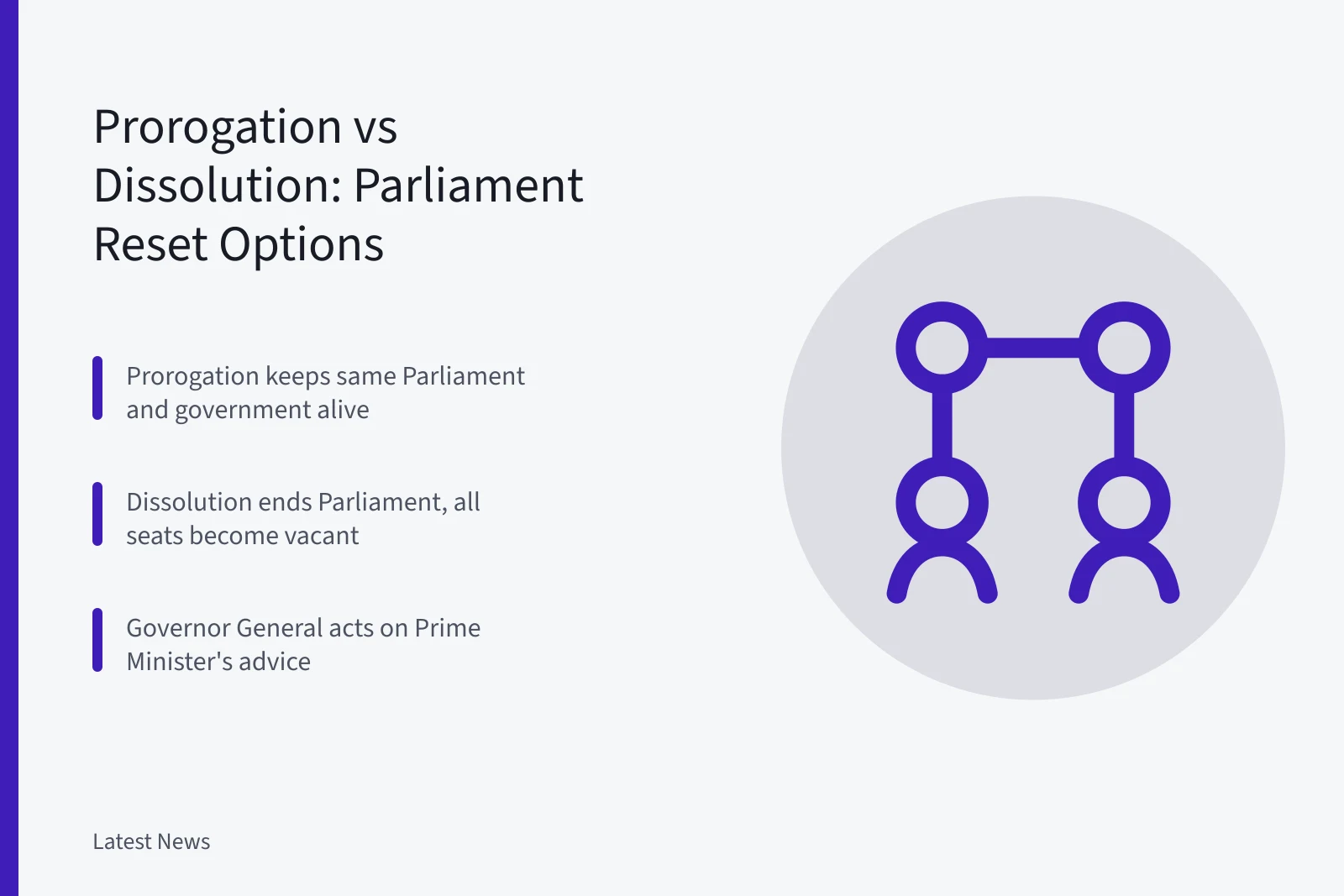
- Prorogation ends a session of Parliament but keeps the same Parliament and the same government alive. Dissolution ends the Parliament itself and triggers a general election.
- The Governor General acts on the Prime Minister's advice for both, but the power is formally the Crown's under section 38 of the Constitution Act, 1867.
- Prorogation wipes the order paper. Bills that have not received Royal Assent die and must be reintroduced from the start in the next session.
- Dissolution is routine after a majority government has finished its mandate. Prorogation is the contested one, because it can be used to avoid a confidence vote.
- Neither tool changes who holds power by itself. Only an election or a Commons vote does that.
What is being compared
Two procedures that both look like Parliament stopping, and neither is an election on its own. Prorogation closes a session. Members keep their seats, committees stop meeting, and a new session opens later with a Speech from the Throne.
Dissolution ends a Parliament. Every seat becomes vacant, writs are issued, and an election follows under the Canada Elections Act. The government stays in office in a caretaker role until the result is known.
The distinction matters most when a government faces a confidence vote it expects to lose. The Constitution Act provisions on summoning, proroguing, and dissolving Parliament set out the formal authority, and the general principles of parliamentary dissolution explain how Westminster systems handle the transition.
The criteria that matter
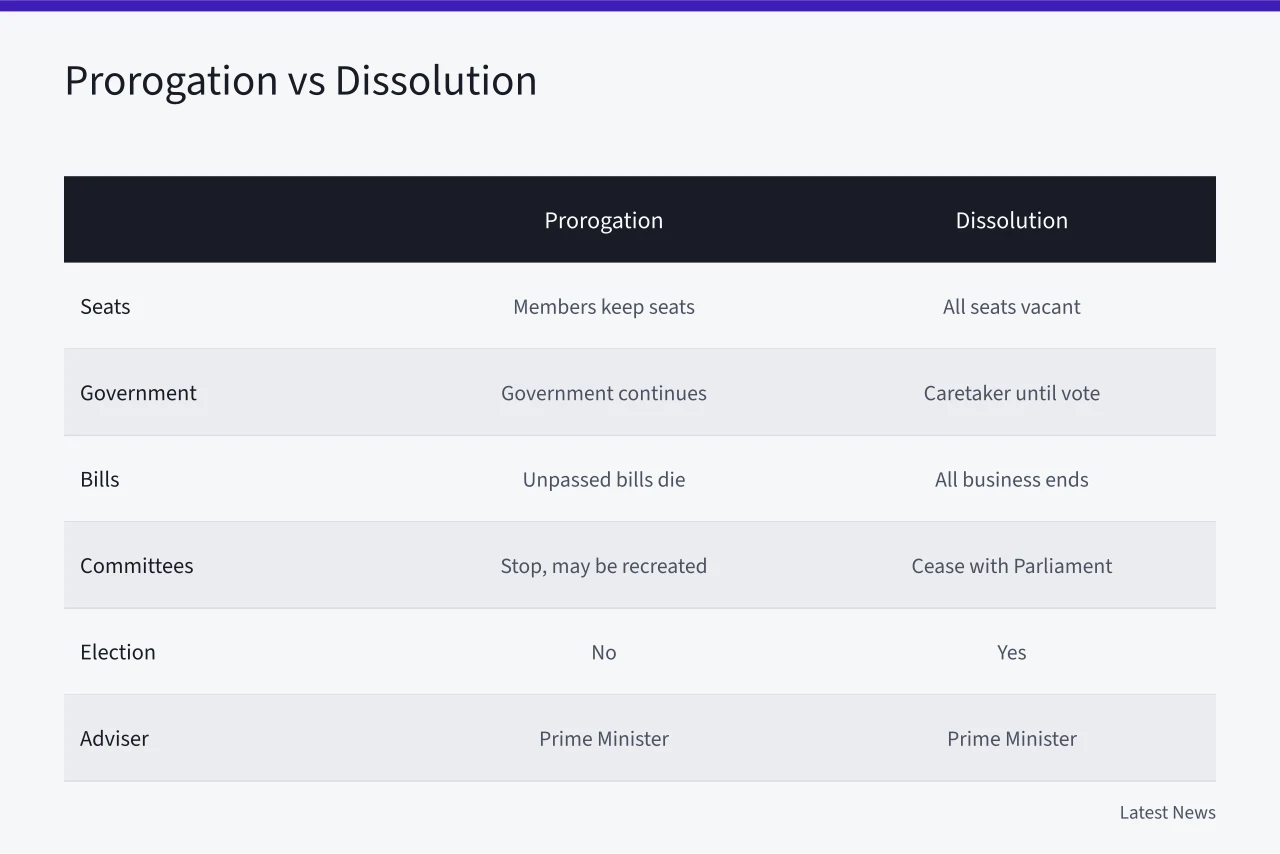
| Criterion | Prorogation | Dissolution |
|---|---|---|
| Effect on seats | Members keep their seats | All seats become vacant |
| Effect on government | Government continues | Caretaker government until the vote |
| Effect on bills | Unpassed bills die, reintroduced later | All business ends, new Parliament starts fresh |
| Effect on committees | Committees stop, may be recreated | Committees cease with the Parliament |
| Election required | No | Yes |
| Who advises | Prime Minister advises the Governor General | Prime Minister advises the Governor General |
| Typical trigger | End of a session, or a reset | End of a mandate, or a lost confidence vote |
A reader who wants the background on how prorogation works in Canadian practice can start with how prorogation differs from dissolution in Canadian parliamentary practice.
Option by option
Prorogation resets the legislative clock. The government keeps the House, keeps its ministers, and returns with a throne speech that restates its plan. Anything mid-flight, from a committee study to a bill at second reading, is gone unless it is reintroduced.
Governments use it for ordinary housekeeping: ending a session before a budget, clearing a crowded calendar, or opening a fresh agenda. It becomes politically charged when the timing coincides with an inquiry or a confidence motion.
Dissolution is the cleaner break. The Governor General dissolves Parliament, the Chief Electoral Officer issues writs, and a campaign begins. The House of Commons does not meet again until after the election. Nothing carries over, including private members' bills and committee evidence.
Where each one wins
Prorogation is the right tool at the end of a session when the government wants to keep its mandate and start a new one with a throne speech. It is also the standard way to clear the order paper before a budget.
Dissolution is the right tool when the government has lost the confidence of the House, or when a majority government reaches the end of its mandate and wants a fresh mandate. It is the only path that produces an election.
For a reader tracking how a story moves through Ottawa, the practical difference is what survives. Prorogation preserves the Parliament and the government. Dissolution preserves neither.
A prorogation that is used to escape a confidence vote is legal, but the Governor General can refuse advice in exceptional cases.
Example: the 2008 prorogation request
In December 2008, Prime Minister Stephen Harper asked Governor General Michaëlle Jean to prorogue Parliament before an expected confidence vote on the government's budget. Jean granted the request. Parliament returned in January 2009 with a new session and a budget the government survived.
The episode is the standard Canadian example of prorogation used to avoid a defeat in the House. It is also the clearest illustration of the difference: had the government instead asked for dissolution, the country would have gone to an election within weeks.
What none of them solve
Neither procedure changes the balance of power in the House. A minority government that lacks the votes still lacks them after a prorogation, and the same parties still face each other when the House returns.
Prorogation also cannot erase a committee's findings that are already public, and it cannot stop a court case or a provincial inquiry. It only stops the House from sitting. Dissolution does not decide the election, and it does not guarantee the governing party a better result.
Both rest on the same unwritten convention: the Governor General acts on the Prime Minister's advice, and only refuses in exceptional circumstances. That convention is the shared limit, and it is not written into any statute.
Common questions
Does prorogation end a government? No. The government stays in office and the Prime Minister remains in place. The House simply stops meeting until a new session opens with a throne speech.
Can the Governor General refuse a prorogation request? Yes, in exceptional cases, but the convention is to accept the Prime Minister's advice. Refusal is rare and would itself become a constitutional crisis.
Do bills die when Parliament is prorogued? Bills that have not received Royal Assent die on prorogation. They can be reintroduced in the next session, but they start over at first reading.
How often does dissolution happen? Every general election begins with dissolution. A Parliament can last up to five years, and in practice elections usually come sooner.